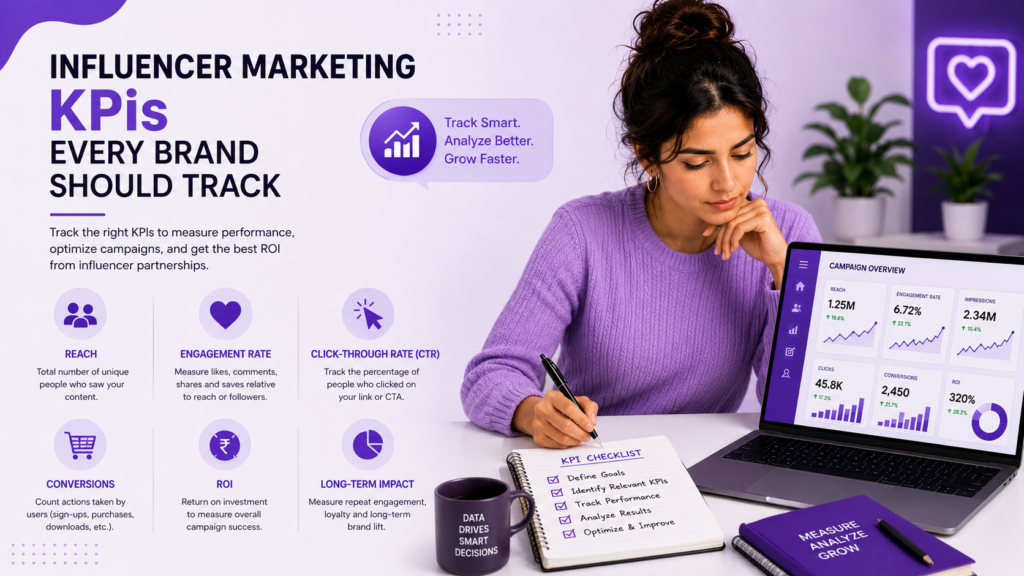
Influencer marketing can help brands build awareness, trust, engagement, leads, sales, and social proof. But to understand whether a campaign is successful, brands need to track the right KPIs.
KPI stands for Key Performance Indicator. In simple words, KPIs are the important numbers that show whether your campaign is moving in the right direction or not.
Many brands make the mistake of judging influencer campaigns only by likes, followers, or views. But these numbers do not always show the full picture.
For example, a campaign may get many likes but no leads. Another campaign may get fewer views but bring high-quality sales. One influencer may bring reach, while another may bring better conversions.
That is why brands should track influencer marketing KPIs based on campaign goals.
If your goal is awareness, track reach and impressions.
If your goal is engagement, track saves, shares, comments, and replies.
If your goal is traffic, track link clicks and website visits.
If your goal is leads, track inquiries, signups, and cost per lead.
If your goal is sales, track revenue, coupon usage, conversion rate, and ROI.
In this blog, we will explain the most important influencer marketing KPIs every brand should track before, during, and after a campaign.
What Are Influencer Marketing KPIs?
Influencer marketing KPIs are measurable values that help brands evaluate influencer campaign performance.
These KPIs show how well an influencer campaign is performing against the brand’s goal.
For example:
- Reach shows how many people saw your campaign.
- Engagement shows how people interacted with the content.
- Link clicks show how many people visited your website.
- Leads show how many potential customers showed interest.
- Sales show how much revenue the campaign generated.
- ROI shows whether the campaign gave a good return compared to the cost.
The right KPI depends on what your brand wants to achieve.
There is no single KPI that works for every influencer campaign. A product launch campaign, sales campaign, app download campaign, and brand awareness campaign will all need different KPIs.
Why Influencer Marketing KPIs Matter
Tracking KPIs helps brands make better decisions.
Without KPIs, influencer marketing becomes guesswork. You may know that a post got likes, but you will not know whether the campaign created real value for your brand.
Here is why KPIs are important.
1. KPIs Help You Measure Campaign Success
KPIs show whether your campaign achieved its goal.
If your goal was awareness, KPIs like reach, impressions, and video views will show how many people discovered your brand.
If your goal was sales, KPIs like revenue, orders, coupon usage, and conversion rate will show whether the campaign generated business.
2. KPIs Help You Compare Influencers
Not all influencers perform the same way.
One creator may bring high reach. Another may bring better engagement. Another may bring more qualified leads.
When you track KPIs properly, you can compare influencers more fairly and decide who is worth working with again.
3. KPIs Help You Improve Future Campaigns
KPI data helps brands understand what worked and what did not.
You can learn:
- Which influencer performed best
- Which content format worked best
- Which platform gave better results
- Which audience responded better
- Which message created more action
- Which campaign type gave better ROI
This helps you plan smarter campaigns in the future.
4. KPIs Help You Avoid Wasting Budget
If a campaign does not perform well, KPIs help you identify the problem.
Maybe the influencer’s audience was not relevant.
Maybe the content format was weak.
Maybe the landing page did not convert.
Maybe the campaign goal was not clear.
Maybe the offer was not attractive.
Without KPIs, brands may keep spending money without knowing what needs to improve.
Influencer Marketing KPIs Every Brand Should Track
Below are the most important KPIs brands should track in influencer marketing.
1. Reach
Reach shows how many unique people saw the influencer’s content.
For example, if 50,000 people saw a reel, the reach is 50,000.
Reach is important because it tells you how many people were exposed to your brand message.
When to Track Reach
Track reach when your campaign goal is:
- Brand awareness
- Product launch
- Event promotion
- New market entry
- Brand recall
- Top-of-funnel visibility
Why Reach Matters
Reach helps brands understand how many people discovered the brand through the influencer.
However, reach alone does not guarantee results. A campaign can have high reach but low engagement or low sales.
That is why reach should be tracked along with other KPIs.
2. Impressions
Impressions show how many times the content was displayed.
One person can see the same content more than once, so impressions are usually higher than reach.
For example, if one user sees the same post three times, it counts as three impressions.
When to Track Impressions
Track impressions when your goal is:
- Brand visibility
- Repeated exposure
- Awareness
- Campaign recall
- Content distribution
Difference Between Reach and Impressions
Reach means unique people.
Impressions mean total views or displays.
If your impressions are much higher than reach, it means people are seeing your content multiple times.
This can be good for brand recall.
3. Video Views
Video views show how many times people watched the influencer’s video content.
This KPI is important for platforms like Instagram Reels, YouTube, YouTube Shorts, Facebook, and other video-first platforms.
When to Track Video Views
Track video views when your campaign uses:
- Reels
- Shorts
- YouTube videos
- Product demos
- Tutorials
- Reviews
- Explainer videos
- Launch videos
Why Video Views Matter
Video views show how much visibility your video content received.
But brands should not only track views. They should also check watch time, retention, comments, saves, shares, and clicks.
A video with fewer views but better watch time and stronger action can be more valuable than a viral video with no conversions.
4. Engagement Rate
Engagement rate shows how actively people interact with influencer content.
Engagement can include:
- Likes
- Comments
- Shares
- Saves
- Story replies
- Poll responses
- Reactions
- Clicks
Engagement rate is usually calculated as:
Engagement Rate = Total Engagement / Reach or Followers × 100
Why Engagement Rate Matters
Engagement rate helps brands understand whether the audience is interested in the content.
A high engagement rate can show that the audience is active and connected with the influencer.
But brands should also check engagement quality, not only engagement quantity.
5. Comment Quality
Comment quality is one of the most important KPIs for understanding real audience interest.
Many brands only count the number of comments, but the quality of comments matters more.
Good Comment Quality Looks Like:
- Product-related questions
- Personal experiences
- Buying interest
- Detailed opinions
- Audience discussion
- People tagging friends
- Questions about price, features, or availability
Poor Comment Quality Looks Like:
- “Nice”
- “Great”
- “Amazing”
- “Wow”
- Only emojis
- Repeated comments
- Comments from suspicious accounts
Meaningful comments show that the audience is paying attention.
For influencer marketing, real conversation is more valuable than generic engagement.
6. Saves
Saves show how many people saved the influencer’s content for later.
This is a strong engagement KPI because people usually save content when they find it useful, informative, or worth revisiting.
When to Track Saves
Track saves for content like:
- Product guides
- Tips
- Tutorials
- Educational posts
- Recommendations
- Checklists
- Before-after content
- Shopping inspiration
- Travel guides
- Fitness routines
Why Saves Matter
Saves show deeper interest than likes.
If people save a post about your product, it means they may want to come back to it later.
For brands, saves can indicate strong content value.
7. Shares
Shares show how many people shared the influencer’s content with others.
This is one of the strongest organic growth signals.
Why Shares Matter
When people share content, they are helping spread your brand message.
Shares can increase:
- Organic reach
- Brand awareness
- Word-of-mouth
- Trust
- Content visibility
A share means the content was useful, entertaining, relatable, or valuable enough for someone to send it to another person.
For brands, this is a powerful KPI.
8. Story Views
Story views show how many people watched the influencer’s stories.
Stories are important because they often reflect the influencer’s active audience.
An influencer may have a large follower count, but story views can show how many people are actually paying attention to their daily content.
When to Track Story Views
Track story views when your campaign includes:
- Story promotions
- Link stickers
- Polls
- Q&A
- Flash offers
- Product reminders
- Behind-the-scenes content
Why Story Views Matter
Story views can give brands a more realistic view of active audience size.
If an influencer has 100,000 followers but only gets very low story views, the active audience may be much smaller than the follower count suggests.
9. Story Replies and Poll Responses
Story replies and poll responses show direct interaction from the audience.
These KPIs are useful for measuring audience interest and participation.
Examples of Story Interaction
- Replies to product questions
- Poll votes
- Quiz responses
- “Ask me anything” questions
- Link sticker taps
- Direct messages
- Emoji reactions
Story replies can be very useful because they show real-time audience response.
For brands, this can help understand whether people are curious about the product or campaign.
10. Link Clicks
Link clicks show how many people clicked the link shared by the influencer.
This is a very important KPI for traffic-focused campaigns.
When to Track Link Clicks
Track link clicks when your campaign goal is:
- Website traffic
- Product page visits
- App downloads
- Landing page visits
- Lead generation
- Online sales
- Event registration
Why Link Clicks Matter
Link clicks show that the audience moved from just watching content to taking action.
However, clicks alone are not enough. Brands should also track what users do after clicking.
Do they stay on the website?
Do they fill out a form?
Do they add products to cart?
Do they buy?
Do they download the app?
Link clicks are the bridge between social engagement and business results.
11. Website Traffic
Website traffic shows how many visitors came to your website from the influencer campaign.
Brands can track this using UTM links, analytics tools, referral data, or dedicated landing pages.
Important Website Traffic KPIs
Track:
- Sessions
- Users
- Page views
- Time on page
- Bounce rate
- Landing page visits
- Add to cart
- Form submissions
- Conversion rate
Why Website Traffic Matters
Website traffic helps brands understand whether the influencer is sending interested people to the brand’s website.
But traffic quality is important.
A creator who sends fewer but highly interested visitors may be more valuable than a creator who sends many low-quality visitors.
12. Leads
Leads are potential customers who show interest in your product or service.
A lead can be:
- Form submission
- Demo request
- WhatsApp inquiry
- Phone call
- Email signup
- Newsletter signup
- Free trial signup
- Consultation request
- Event registration
When to Track Leads
Track leads when your campaign goal is:
- B2B marketing
- SaaS promotion
- Education services
- Real estate inquiries
- Finance products
- High-ticket products
- Service-based businesses
- App signups
Why Leads Matter
Leads show that people are not just watching content. They are taking interest in your brand.
For many businesses, leads are more important than likes or views.
13. Cost Per Lead
Cost per lead shows how much money you spent to generate one lead.
Formula:
Cost Per Lead = Total Campaign Cost / Total Leads
For example, if you spent ₹50,000 and got 500 leads:
Cost Per Lead = ₹50,000 / 500
Cost Per Lead = ₹100
This means each lead cost ₹100.
Why Cost Per Lead Matters
Cost per lead helps brands understand campaign efficiency.
If one influencer brings leads at ₹80 and another brings leads at ₹300, you can compare which creator is more cost-effective.
But lead quality should also be checked. A lower cost per lead is useful only when the leads are relevant.
14. Sales
Sales are one of the most important KPIs for performance-focused influencer campaigns.
Sales show how many purchases were generated through the campaign.
Brands can track sales using:
- Coupon codes
- UTM links
- Affiliate links
- Landing pages
- Pixel tracking
- Website analytics
- CRM data
Why Sales Matter
Sales show direct business impact.
However, brands should remember that not every influencer campaign is designed for immediate sales. Some campaigns are for awareness, trust, or content creation.
Sales should be the main KPI only when the campaign goal is revenue.
15. Revenue
Revenue shows the total money generated from the influencer campaign.
For example, if an influencer campaign generates 200 orders and the average order value is ₹1,000, total revenue is ₹2,00,000.
Revenue helps brands understand the financial impact of the campaign.
Revenue vs Sales
Sales usually means number of orders.
Revenue means total money earned.
Both are important for e-commerce, D2C, app subscriptions, online courses, and other revenue-focused campaigns.
16. Conversion Rate
Conversion rate shows the percentage of users who took the desired action.
Formula:
Conversion Rate = Conversions / Total Visitors × 100
For example, if 1,000 people visited your landing page and 50 purchased:
Conversion Rate = 50 / 1,000 × 100
Conversion Rate = 5%
Why Conversion Rate Matters
Conversion rate helps brands understand the quality of traffic and landing page performance.
If link clicks are high but conversions are low, the problem may be:
- Wrong audience
- Weak landing page
- Poor offer
- High price
- Slow website
- Lack of trust
- Confusing checkout
- Product mismatch
This KPI helps brands improve the full campaign journey.
17. Coupon Code Usage
Coupon code usage shows how many customers used a unique influencer code.
For example:
- RIA10
- AMAN15
- BEAUTY20
- INFLUNETS10
Coupon codes help brands attribute sales to specific influencers.
Why Coupon Codes Matter
Coupon codes are simple and useful for tracking influencer performance.
They help brands understand:
- Which influencer drove sales
- Which offer worked best
- How many customers converted
- What revenue came from each creator
However, coupon codes may not track every sale because some users may buy without using the code.
That is why coupon codes should be used with UTM links and analytics tracking.
18. Customer Acquisition Cost
Customer Acquisition Cost, or CAC, shows how much it costs to acquire one customer.
Formula:
CAC = Total Campaign Cost / Number of New Customers
For example, if your campaign cost is ₹1,00,000 and you got 250 new customers:
CAC = ₹1,00,000 / 250
CAC = ₹400
Why CAC Matters
CAC is important for brands that want to measure profitability.
If your average profit per customer is lower than your CAC, the campaign may not be profitable.
But if customers repeat purchases later, the long-term value may still be strong.
19. Return on Investment
ROI shows the return your brand received compared to campaign cost.
Formula:
ROI = (Revenue Generated – Campaign Cost) / Campaign Cost × 100
For example, if your campaign cost is ₹80,000 and revenue generated is ₹2,00,000:
ROI = (₹2,00,000 – ₹80,000) / ₹80,000 × 100
ROI = 150%
Why ROI Matters
ROI is one of the most important KPIs for sales-driven campaigns.
It helps brands understand whether the campaign generated more value than it cost.
However, ROI should be measured according to campaign goal. If your campaign goal was awareness or UGC, direct revenue may not show the full value.
20. Content Asset Value
Influencer marketing does not only create reach. It can also create content assets.
Brands can reuse creator content for:
- Social media posts
- Paid ads
- Website sections
- Landing pages
- Product pages
- Email marketing
- Testimonials
- YouTube Shorts
- Reels
- Case studies
If the brand has usage rights, influencer content can continue creating value after the original post.
Why Content Asset Value Matters
Sometimes, a campaign may not generate huge direct sales immediately, but it may give the brand high-quality content that can be reused in ads and marketing.
This is especially useful for UGC campaigns.
Brands should track:
- Number of usable content pieces
- Cost per content asset
- Ad performance of reused content
- Engagement on reposted content
- Creative quality
- Usage rights
Influencer KPIs Based on Campaign Goals
Different campaign goals need different KPIs.
For Brand Awareness
Track:
- Reach
- Impressions
- Video views
- Brand mentions
- Profile visits
- Follower growth
For Engagement
Track:
- Likes
- Comments
- Saves
- Shares
- Story replies
- Poll responses
- Engagement rate
For Website Traffic
Track:
- Link clicks
- Website visits
- Sessions
- Time on page
- Bounce rate
- Landing page visits
For Lead Generation
Track:
- Form submissions
- Demo requests
- WhatsApp inquiries
- Phone calls
- Email signups
- Cost per lead
For Sales
Track:
- Orders
- Revenue
- Coupon code usage
- Conversion rate
- Customer acquisition cost
- ROI
For App Downloads
Track:
- App installs
- Cost per install
- Signup rate
- Active users
- Trial starts
- Paid conversions
For UGC Content
Track:
- Number of content pieces
- Content quality
- Cost per asset
- Usage rights
- Reuse performance
- Ad performance
How to Track Influencer Marketing KPIs
Brands can track influencer marketing KPIs using a mix of platform data, website analytics, and campaign tracking tools.
1. Use UTM Links
UTM links help track website traffic from each influencer.
Create a separate UTM link for every creator and campaign.
This helps you see which influencer brought traffic, leads, or conversions.
2. Use Unique Coupon Codes
Give each influencer a unique coupon code.
This helps track sales and revenue from individual creators.
3. Use Dedicated Landing Pages
A campaign-specific landing page makes tracking easier.
You can measure visits, conversions, form submissions, and sales more clearly.
4. Ask for Influencer Insights
Ask creators to share post-campaign insights such as:
- Reach
- Impressions
- Story views
- Saves
- Shares
- Link clicks
- Audience demographics
5. Use Website Analytics
Website analytics tools help track what users do after clicking the influencer’s link.
You can analyze traffic quality, conversion rate, and revenue.
6. Compare Creator Performance
After the campaign, compare all influencers using the same KPI format.
This helps identify which creators should be used again.
Common Mistakes Brands Make While Tracking KPIs
1. Tracking Too Many KPIs
Brands do not need to track every possible metric. Track the KPIs that match your campaign goal.
2. Focusing Only on Followers
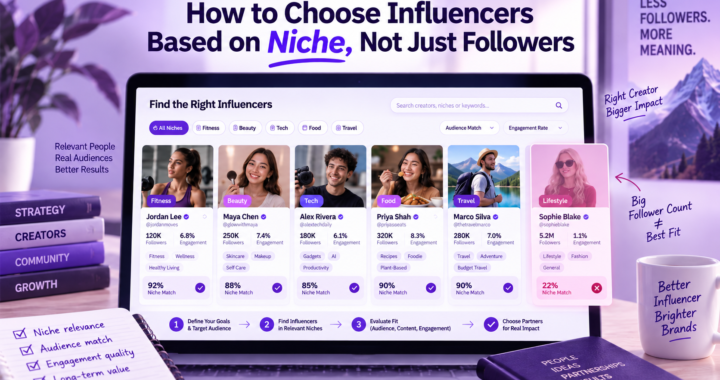
Followers do not always show real influence. Audience relevance and engagement quality matter more.
3. Ignoring Engagement Quality
A high number of comments is not useful if most comments are fake or generic.
4. Not Using Tracking Links
Without tracking links, it becomes difficult to know which influencer drove traffic or conversions.
5. Not Calculating Total Campaign Cost
Campaign cost should include influencer fee, product samples, shipping, agency fees, platform fees, and paid boosting.
6. Comparing Different Goals Incorrectly
Do not compare an awareness campaign with a sales campaign using the same KPI.
7. Not Asking for Reports
Brands should always ask influencers for post-campaign performance insights.
Influencer Marketing KPI Checklist for Brands
Before launching your next influencer campaign, use this KPI checklist:
- Define the campaign goal.
- Select 3 to 5 main KPIs.
- Create UTM links for each influencer.
- Assign unique coupon codes if sales are important.
- Decide reporting format before the campaign starts.
- Ask influencers for audience insights.
- Track website traffic and conversions.
- Calculate total campaign cost.
- Compare influencer performance after the campaign.
- Use learnings to improve the next campaign.
This simple checklist can help brands measure campaigns more clearly.
How Influnets Can Help Brands Track Better Campaign Decisions
Choosing influencers is only the first step. Brands also need to understand which creators are relevant, which campaigns are worth running, and which partnerships should continue.
Influnets helps brands discover and connect with creators for influencer campaigns in a more organized way.
With better creator discovery and campaign planning, brands can focus on the KPIs that matter most: audience relevance, engagement quality, traffic, leads, sales, and long-term creator value.
Instead of choosing influencers only by follower count, brands should choose creators based on campaign goals and measurable outcomes.
That is where a platform like Influnets can make influencer marketing simpler and more structured.
Conclusion
Influencer marketing KPIs help brands understand whether a campaign is actually working.
Instead of focusing only on likes, followers, or views, brands should track KPIs based on their campaign goal.
For awareness, track reach, impressions, and video views.
For engagement, track comments, saves, shares, and replies.
For traffic, track link clicks and website visits.
For leads, track inquiries and cost per lead.
For sales, track revenue, coupon usage, conversion rate, CAC, and ROI.
The right KPIs help brands measure performance, compare influencers, improve future campaigns, and avoid wasting budget.
Influencer marketing becomes more powerful when brands stop guessing and start tracking.
If your brand wants better results from influencer campaigns, start by choosing the right KPIs before the campaign goes live.
FAQs
What are influencer marketing KPIs?
Influencer marketing KPIs are measurable values that help brands track campaign performance. These can include reach, impressions, engagement rate, link clicks, leads, sales, revenue, conversion rate, and ROI.
Which KPIs are most important in influencer marketing?
The most important KPIs depend on the campaign goal. For awareness, reach and impressions matter. For engagement, comments, saves, and shares matter. For sales, revenue, coupon usage, conversion rate, and ROI matter.
Is engagement rate an important influencer marketing KPI?
Yes, engagement rate is important because it shows how actively the audience interacts with influencer content. However, brands should also check engagement quality, not just the number.
How do brands track influencer sales?
Brands can track influencer sales using unique coupon codes, UTM links, affiliate links, dedicated landing pages, website analytics, and conversion tracking.
What KPIs should brands track for influencer awareness campaigns?
For awareness campaigns, brands should track reach, impressions, video views, brand mentions, profile visits, and follower growth.
What KPIs should brands track for influencer lead generation campaigns?
For lead generation campaigns, brands should track form submissions, demo requests, WhatsApp inquiries, phone calls, email signups, and cost per lead.
What is the difference between reach and impressions?
Reach means the number of unique people who saw the content. Impressions mean the total number of times the content was displayed, including repeat views from the same people.
How can Influnets help brands with influencer marketing?
Influnets helps brands discover and connect with relevant creators, making influencer selection and campaign planning more organized for better influencer marketing results.