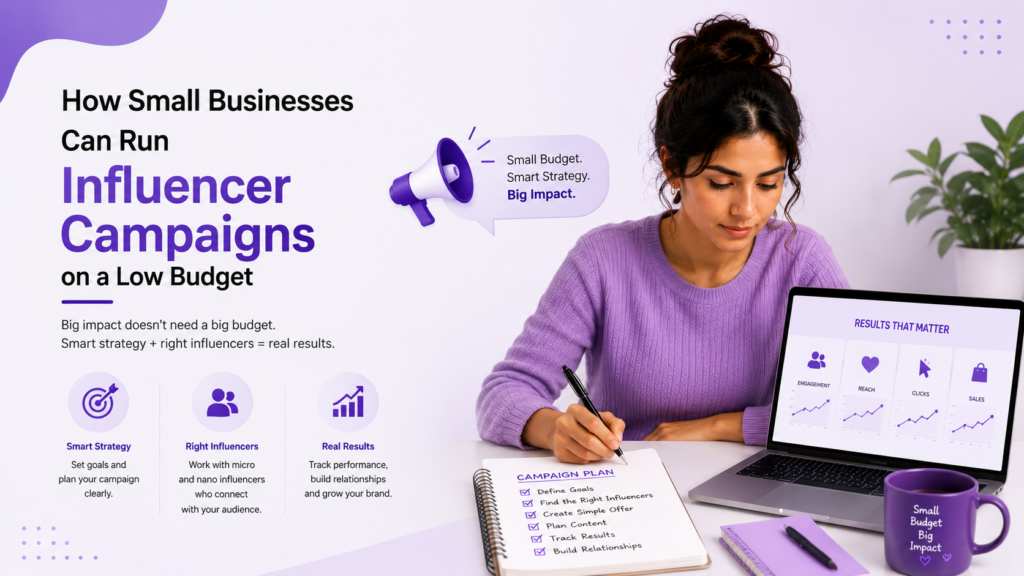
Influencer marketing is not only for big brands with large budgets.
Small businesses, startups, local stores, D2C brands, service providers, cafés, salons, gyms, coaching institutes, and online sellers can also use influencer marketing to reach the right audience.
The common problem is budget.
Many small business owners think influencer marketing is expensive because they imagine celebrity influencers, big Instagram pages, or creators with millions of followers. But the truth is different.
Small businesses do not always need celebrity influencers. They need relevant creators who can speak to the right audience.
A local creator with 5,000 real followers in your city can sometimes give better results than a large influencer with lakhs of followers from different locations.
The key is to plan smartly.
In this blog, we will explain how small businesses can run influencer campaigns on a low budget, choose the right creators, avoid common mistakes, and measure results properly.
Why Influencer Marketing Works for Small Businesses
Small businesses often depend on trust, word-of-mouth, and local visibility. Influencer marketing supports all three.
When a creator recommends your product or service, their audience may see your brand as more trustworthy because the message is coming from a person they already follow.
For small businesses, influencer marketing can help with:
- Local awareness
- Product discovery
- Store visits
- Website traffic
- Social media growth
- Product reviews
- User-generated content
- Brand trust
- Sales and inquiries
- Community building
For example:
A café can invite local food creators.
A salon can work with beauty creators.
A gym can collaborate with fitness creators.
A clothing brand can work with fashion creators.
A coaching institute can work with student creators.
A small SaaS tool can collaborate with business or productivity creators.
Influencer marketing becomes powerful when the creator’s audience matches your ideal customer.
Can Small Businesses Do Influencer Marketing Without a Big Budget?
Yes, small businesses can run influencer campaigns without a big budget.
The goal is not to hire the most famous influencer. The goal is to find creators who are relevant, genuine, and affordable.
Small businesses can start with:
- Nano influencers
- Micro influencers
- Local creators
- Niche creators
- Barter collaborations
- Product gifting
- Affiliate-based collaborations
- UGC creators
- Customer creators
- Community-based influencers
Instead of spending the full budget on one big influencer, small businesses can test multiple smaller creators and see who performs best.
This reduces risk and helps the business learn what works.
Step-by-Step Guide to Run Influencer Campaigns on a Low Budget
1. Start With a Clear Campaign Goal
Before contacting influencers, decide what you want from the campaign.
Your goal can be:
- Brand awareness
- Store visits
- Website traffic
- Social media followers
- Product reviews
- Leads
- Sales
- App downloads
- Event registrations
- User-generated content
A clear goal helps you choose the right influencer and content format.
For example:
If your goal is local store visits, choose local creators.
If your goal is sales, use coupon codes or affiliate links.
If your goal is content, work with UGC creators.
If your goal is awareness, choose creators with good reach in your target audience.
Do not run a campaign just because other brands are doing it. Run it with a clear purpose.
2. Define Your Target Audience
Small businesses should be very clear about who they want to reach.
Ask yourself:
- Who is my ideal customer?
- What is their age group?
- Where are they located?
- What language do they speak?
- What problems do they have?
- Which social platforms do they use?
- What type of creators do they follow?
For example, if you run a women’s clothing store in Jaipur, your target audience may be young women in Jaipur and nearby cities who follow fashion, lifestyle, and shopping creators.
If you run a coaching institute, your audience may be students and parents in a specific city.
The more specific your target audience is, the easier it becomes to find the right influencer.
3. Work With Nano Influencers
Nano influencers usually have a smaller audience, but they often have strong trust and personal connection with followers.
They are a great option for low-budget campaigns.
Nano influencers are useful for:
- Local businesses
- Small brands
- Product trials
- Community campaigns
- Early-stage startups
- Niche products
- Authentic reviews
- Barter collaborations
For example, a local café can invite 5 to 10 nano food creators for a tasting experience. Each creator may post stories, reels, or reviews. This can create local buzz without a huge budget.
Nano influencers may not give massive reach, but they can give more relatable and authentic promotion.
4. Choose Micro Influencers Carefully
Micro influencers usually have a larger audience than nano influencers but are still more affordable than macro influencers.
They are useful when you want a balance of reach and trust.
Small businesses can work with micro influencers for:
- Product launches
- D2C promotions
- Brand awareness
- App promotions
- Educational content
- Product reviews
- Lead generation
- Social proof
But before choosing a micro influencer, check:
- Audience relevance
- Engagement quality
- Comment quality
- Audience location
- Past collaborations
- Fake followers
- Content style
- Pricing
Do not choose micro influencers only by follower count. Choose them based on audience fit and campaign goal.
5. Try Product Gifting or Barter Collaborations
If your budget is very limited, product gifting can be a good starting point.
In product gifting, you send your product or offer your service to the creator. In return, they may create content, review your product, or share their experience.
This works best when your product is genuinely useful, attractive, or experience-based.
Examples:
- A skincare brand sends product samples.
- A café offers a food tasting experience.
- A salon offers a free service.
- A fashion brand sends an outfit.
- A fitness brand sends supplements or accessories.
- A coaching platform gives free course access.
However, brands should be clear and respectful. Do not assume every creator will post for free. Some creators may accept barter, while others may charge a fee.
Always discuss expectations clearly before sending products.
6. Use Affiliate or Commission-Based Campaigns
Affiliate campaigns are useful for small businesses because payment is linked to performance.
In this model, the influencer earns a commission for each sale, signup, lead, or conversion they generate.
This reduces upfront risk for the brand.
For example:
A brand can give the influencer a unique link or coupon code. Whenever someone buys using that code, the influencer earns a commission.
Affiliate campaigns work well for:
- E-commerce brands
- D2C brands
- Online courses
- Apps
- Digital products
- Fitness programs
- Subscription services
- Beauty and skincare products
But to make affiliate campaigns work, the product should have a clear offer and the creator should trust the brand.
Creators may not accept pure commission if the brand is unknown or the product does not convert well. A small fixed fee plus commission can be a better option.
7. Focus on Local Creators
For small businesses, local creators can be more valuable than big influencers.
If your business serves a specific city, area, or region, local creators help you reach people who can actually visit or buy from you.
Local creators are useful for:
- Cafés
- Restaurants
- Gyms
- Salons
- Clinics
- Events
- Coaching institutes
- Real estate
- Fashion stores
- Local services
- Retail shops
For example, if you run a restaurant in Delhi, a Delhi food blogger is more useful than a national influencer whose audience is spread across different cities.
Local relevance can make your campaign more practical and cost-effective.
8. Create a Simple Campaign Brief
Even low-budget campaigns need a proper brief.
A campaign brief helps the influencer understand your expectations.
Your brief should include:
- Brand introduction
- Campaign goal
- Product or service details
- Target audience
- Key message
- Content format
- Number of posts or stories
- Posting deadline
- Hashtags
- Brand mentions
- Do’s and don’ts
- Offer or coupon code
- Tracking link
- Payment or barter terms
Keep the brief simple, but clear.
Do not over-control the influencer’s content. Give direction, but allow creative freedom. Creators know how to talk to their audience.
9. Start With a Small Test Campaign
Small businesses should avoid spending the full budget in one campaign.
Start small.
For example:
- Work with 3 nano influencers first.
- Test 1 micro influencer.
- Run 1 product gifting campaign.
- Try 1 affiliate collaboration.
- Test 1 UGC creator.
After the campaign, check the results.
Track:
- Reach
- Engagement
- Comments
- Story views
- Link clicks
- Leads
- Sales
- Store visits
- Coupon code usage
- Content quality
Once you know what works, you can increase the budget slowly.
Testing helps small businesses avoid wasting money.
10. Use Unique Coupon Codes and Tracking Links
Low-budget campaigns still need tracking.
If you do not track results, you will not know whether the campaign worked.
Use:
- Unique coupon codes
- UTM links
- Affiliate links
- Dedicated landing pages
- WhatsApp inquiry links
- Google Forms
- Website analytics
- Instagram insights
- Creator reports
For example:
Give each influencer a unique code like:
- RIA10
- AMAN15
- FOODIE20
- INFLUNETS10
This helps you know which creator brought sales or inquiries.
For local businesses, you can also ask customers, “How did you hear about us?” and note influencer names.
11. Reuse Creator Content
One of the best ways to get more value from a low-budget influencer campaign is to reuse creator content.
If the influencer agrees to usage rights, you can use their content for:
- Instagram posts
- Reels
- Facebook posts
- Website testimonials
- Product pages
- Landing pages
- WhatsApp promotions
- Ads
- Email campaigns
- YouTube Shorts
This gives your brand extra value beyond the original post.
For example, if a creator makes a good product review video, you can use it later as social proof on your website or in paid ads.
Always discuss content usage rights before the campaign starts.
12. Build Long-Term Relationships
Small businesses should not treat every influencer collaboration as a one-time transaction.
If a creator performs well, build a long-term relationship.
Long-term creator partnerships can help your brand because:
- The audience sees repeated mentions.
- Trust builds over time.
- The creator understands your product better.
- Content becomes more natural.
- Campaign planning becomes easier.
- Cost may become more efficient.
Instead of working with 20 random creators once, it may be better to work with 5 good creators repeatedly.
Consistency builds trust.
Low-Budget Influencer Campaign Ideas for Small Businesses
Here are some simple campaign ideas that small businesses can try.
1. Product Review Campaign
Send your product to nano or micro influencers and ask them to share an honest review.
Best for:
- Beauty brands
- Food brands
- Fashion brands
- Fitness products
- Gadgets
- Home products
2. Local Visit Campaign
Invite local creators to your store, café, salon, gym, clinic, or event.
Best for:
- Restaurants
- Cafés
- Salons
- Gyms
- Local stores
- Events
3. Giveaway Campaign
Collaborate with creators to run a small giveaway.
Best for:
- Social media growth
- Product awareness
- Engagement
- Community building
4. Coupon Code Campaign
Give each influencer a unique discount code to share with their audience.
Best for:
- Sales tracking
- D2C brands
- E-commerce
- Online courses
- Apps
5. UGC Content Campaign
Work with creators to make content for your brand, even if they do not post it on their own page.
Best for:
- Ads
- Website content
- Product pages
- Social media content
- Testimonials
6. Customer Creator Campaign
Encourage happy customers to create content about your brand.
Best for:
- Small brands
- Local businesses
- Community-driven products
- Trust building
Budget-Friendly Influencer Campaign Plan
Here is a simple example for a small business with a limited budget.
Example Budget: ₹10,000 to ₹25,000
A small skincare brand can try:
- 5 nano influencers through product gifting
- 2 micro influencers with small paid collaboration
- 1 giveaway campaign
- Unique coupon codes for each creator
- Reuse rights for best content
Campaign goal:
- Product awareness
- Reviews
- Social proof
- Website traffic
- First few sales
Metrics to track:
- Reach
- Comments
- Saves
- Story views
- Website clicks
- Coupon code usage
- Orders
- Content quality
This type of campaign is small, but it gives learning and content that can be used later.
Common Mistakes Small Businesses Should Avoid
1. Choosing Influencers Only by Followers
Follower count does not guarantee sales or trust. Audience relevance matters more.
2. Not Checking Fake Followers
Always check engagement quality, comments, follower profiles, and audience location.
3. Not Defining Campaign Goals
Without a goal, you cannot measure success.
4. Giving an Unclear Brief
Creators need clear instructions to create useful content.
5. Expecting Instant Sales From Every Post
Influencer marketing can support awareness, trust, traffic, and sales. Not every post will create immediate revenue.
6. Not Tracking Results
Use coupon codes, links, and reports to track performance.
7. Working With Irrelevant Creators
A creator may be popular, but if their audience does not match your customer, the campaign may not work.
8. Spending Full Budget on One Influencer
Small businesses should test multiple creators instead of depending on one person.
How to Choose the Right Influencer on a Low Budget
Before selecting an influencer, check:
- Is their audience relevant?
- Is their engagement real?
- Are comments meaningful?
- Is their audience location useful?
- Does their content match your brand?
- Have they worked with similar brands?
- Are their prices clear?
- Are they professional in communication?
- Can you track results?
- Can you reuse the content?
A good low-budget influencer is not the cheapest creator. A good influencer is the one who can give useful results within your budget.
How Influnets Can Help Small Businesses
Finding affordable and relevant influencers manually can take time.
Small businesses often have limited budgets, small teams, and less time to search, shortlist, and message creators one by one.
Influnets aims to make influencer discovery easier by helping brands connect with relevant creators for their campaigns.
With Influnets, small businesses can explore creators based on category, collaboration type, campaign needs, and audience fit.
Instead of randomly searching for influencers, brands can make the process more organized and focused.
For small businesses, this can save time and help them find creators who fit their budget and goals better.
Conclusion
Small businesses can run influencer campaigns on a low budget if they plan smartly.
You do not need celebrity influencers or huge budgets to start. You need relevant creators, clear goals, good communication, and proper tracking.
Start with nano and micro influencers. Focus on local creators if your business is location-based. Try product gifting, barter, affiliate collaborations, UGC content, and small test campaigns.
Most importantly, track your results.
Influencer marketing works best when brands stop chasing big follower numbers and start focusing on real audience relevance, trust, and measurable outcomes.
For small businesses, the goal should be simple:
Start small, test properly, learn quickly, and scale what works.
FAQs
Can small businesses use influencer marketing?
Yes, small businesses can use influencer marketing by working with nano influencers, micro influencers, local creators, customer creators, and UGC creators. They do not need a large budget to start.
How can small businesses run influencer campaigns on a low budget?
Small businesses can run low-budget influencer campaigns by using product gifting, barter collaborations, affiliate campaigns, local creators, nano influencers, micro influencers, and small test campaigns.
Which influencers are best for small businesses?
Nano and micro influencers are often best for small businesses because they are more affordable, more targeted, and usually have stronger audience trust.
Is product gifting good for influencer marketing?
Yes, product gifting can be useful for small businesses, especially when the product is interesting, useful, or experience-based. However, brands should clearly discuss expectations with creators before sending products.
How much should a small business spend on influencer marketing?
A small business can start with a small test budget based on its goal. Instead of spending everything on one influencer, it is better to test multiple nano or micro creators and then scale what works.
How can small businesses track influencer campaign results?
Small businesses can track results using unique coupon codes, UTM links, affiliate links, landing pages, WhatsApp inquiry links, creator insights, website analytics, and sales data.
Can influencer marketing generate sales for small businesses?
Yes, influencer marketing can generate sales if the creator’s audience is relevant, the offer is strong, the content is trustworthy, and the campaign is tracked properly.
How can Influnets help small businesses?
Influnets helps small businesses discover and connect with relevant creators, making influencer discovery and campaign planning more organized and easier.