Influencer marketing can help brands build trust, reach the right audience, and promote products in a more human way.
But there is one major problem that many brands face before working with influencers: fake followers.
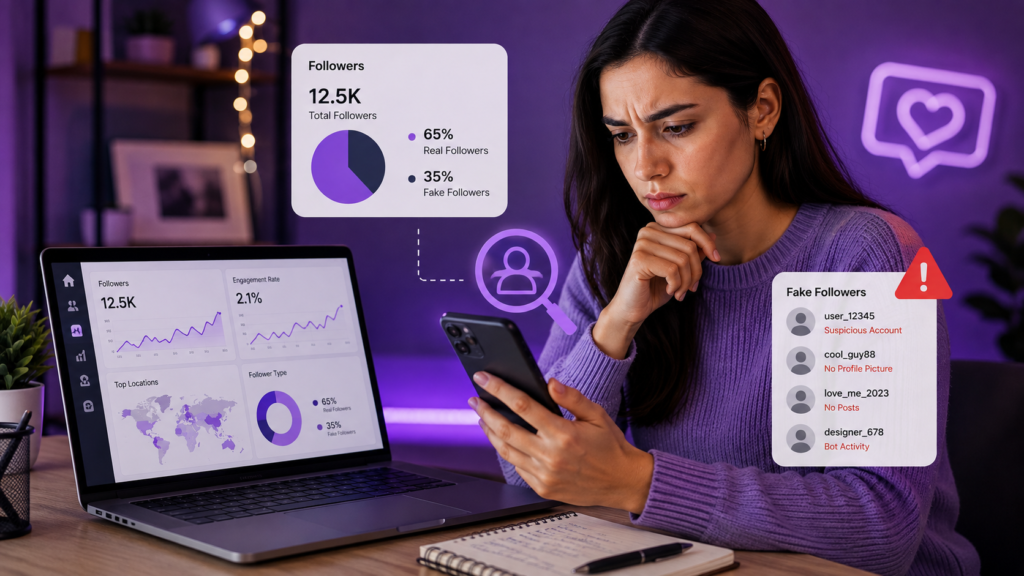
At first, an influencer profile may look impressive. They may have thousands or even lakhs of followers. Their profile may look popular, active, and attractive. But when you look deeper, you may find that many followers are fake, inactive, irrelevant, or created by bots.
For brands, this is a serious issue.
Fake followers do not buy products.
Fake followers do not visit websites.
Fake followers do not download apps.
Fake followers do not become customers.
So, before hiring any influencer, brands should learn how to identify fake followers and fake engagement.
In this blog, we will explain how brands can check whether an influencer’s audience is genuine or fake before starting a collaboration.
What Are Fake Followers?
Fake followers are accounts that follow an influencer but do not represent real, interested, or useful audience members.
These accounts may be:
- Bot accounts
- Inactive accounts
- Purchased followers
- Spam accounts
- Fake profiles
- Irrelevant accounts from unrelated locations
- Accounts created only to increase follower numbers
Some influencers may intentionally buy followers to look more popular. In other cases, fake followers may be added through growth services, engagement groups, or suspicious promotion methods.
For brands, the problem is simple: fake followers make an influencer look bigger than they actually are.
This can lead brands to pay for reach that does not exist.
Why Fake Followers Are a Problem for Brands
Fake followers can damage influencer marketing results in many ways.
1. Wasted Marketing Budget
If a brand pays an influencer based on follower count, fake followers can make the campaign overpriced.
You may think you are paying to reach 1 lakh people, but only a small percentage may be real and relevant.
2. Poor Campaign Performance
Fake followers do not engage, click, buy, or respond.
This can lead to poor results such as:
- Low website traffic
- Low sales
- Low leads
- Low app downloads
- Low genuine engagement
- Poor return on investment
3. Wrong Campaign Decisions
Fake followers can make data look misleading.
A brand may think a creator has strong influence, but in reality, the creator may not have a real active audience.
4. Brand Trust Risk
If a brand repeatedly works with influencers who have fake audiences, it can affect the quality and credibility of the brand’s marketing.
People may also notice if a collaboration looks artificial or forced.
5. No Real Business Impact
The purpose of influencer marketing is not just visibility. Brands want trust, attention, action, and results.
Fake followers do not create any real business impact.
How to Identify Fake Followers Before Hiring an Influencer
Here are the most important things brands should check before working with an influencer.
1. Check the Engagement Rate
Engagement rate shows how actively followers interact with an influencer’s content.
If an influencer has many followers but very low likes, comments, shares, or views, it can be a warning sign.
For example:
If a creator has 200,000 followers but only gets 500 likes and 5 comments on most posts, the audience may not be very active.
This does not always mean the followers are fake, but it should make you check deeper.
A healthy engagement rate depends on the platform, niche, follower size, and content format. Smaller creators often have higher engagement rates because they have a closer relationship with their audience.
When checking engagement, do not only look at one post. Check the last 10 to 15 posts to understand the pattern.
2. Look at Comment Quality
Comments can reveal a lot about audience authenticity.
Real followers usually leave comments that are related to the content.
For example, if an influencer posts a skincare product review, real comments may look like:
- “Is this suitable for oily skin?”
- “How long did it take to show results?”
- “Can I use this with vitamin C?”
- “Where can I buy this?”
- “I tried this product and it worked for me.”
Fake or low-quality comments often look like:
- “Nice”
- “Great”
- “Amazing”
- “Super”
- “Wow”
- “Good post”
- Only emojis
- Repeated comments from random accounts
If most comments are generic, unrelated, or repeated, the engagement may not be genuine.
Brands should always read comments manually before hiring an influencer.
3. Compare Followers With Likes and Views
Follower count should have some connection with likes, comments, story views, and video views.
If an influencer has a very high number of followers but very low content views, it may indicate that the audience is inactive or fake.
For example:
- High followers but very low reel views
- High followers but very few comments
- High followers but low story views
- High followers but weak post reach
This does not automatically prove fake followers because platform algorithms can also affect reach. But if the pattern is consistent across many posts, brands should be careful.
Always compare follower count with actual content performance.
4. Check Sudden Follower Growth
Sudden follower growth can be a warning sign.
If an influencer gains thousands of followers overnight without any viral content, media mention, giveaway, collaboration, or strong reason, the followers may not be organic.
Brands should check whether the growth looks natural.
Natural growth usually happens slowly over time, or sometimes after a viral post.
Suspicious growth may look like:
- Sudden jump in followers
- No matching increase in engagement
- Follower count rising but likes and comments staying the same
- Audience quality becoming weaker after growth
If possible, use social media analytics tools to check growth history.
5. Review Follower Profiles
Brands should manually check some follower profiles.
Open the influencer’s follower list and review random accounts.
Fake follower accounts may have:
- No profile photo
- Strange usernames
- Very few posts
- No real activity
- Following thousands of accounts
- Very few followers
- Repeated or spammy bios
- Unrelated country or language
- No personal identity
- Random profile pictures
Real followers usually look more natural. They may have real photos, normal activity, regular posts, personal bios, and authentic interaction.
You do not need to check every follower. But reviewing a sample can give a basic idea of audience quality.
6. Check Audience Location
Audience location is very important for brands.
If your brand sells only in India, but most of the influencer’s audience is from unrelated countries, the campaign may not give useful results.
For example, if you are a local Indian brand and an influencer’s followers are mostly from countries where you do not sell, then those followers may not help your business.
Before hiring an influencer, ask for audience insights.
Check:
- Top countries
- Top cities
- Audience language
- Regional relevance
- Local audience percentage
Audience mismatch does not always mean fake followers, but it can make the campaign ineffective.
For brands, relevant followers are more valuable than total followers.
7. Check Like-to-Comment Ratio
A natural post usually has some balance between likes and comments.
If a post has many likes but almost no meaningful comments, it may be a sign of weak audience interaction.
Similarly, if a post has many comments but most of them are generic, repeated, or unrelated, that can also be suspicious.
For example:
A post with 10,000 likes and only 3 comments may need deeper checking.
A post with 300 comments, but all comments say “Nice pic” or “Great,” may not show real engagement.
The goal is not to find a perfect ratio. The goal is to check whether the engagement looks natural.
8. Check Story Views and Saves
Public likes and comments can sometimes be manipulated. But story views, saves, shares, and link clicks can give better insight into real audience interest.
Before working with an influencer, brands can ask for:
- Average story views
- Average reel reach
- Average post reach
- Saves
- Shares
- Link clicks
- Website clicks
- Audience insights
- Past campaign performance
If an influencer has 100,000 followers but only gets 500 story views, the real active audience may be much smaller.
Story views are especially useful because they show how many people are actively watching the creator’s updates.
9. Check Content Consistency
Fake or low-quality influencers often have irregular content patterns.
They may post randomly, change niches too often, or promote unrelated products frequently.
Before hiring an influencer, check:
- How often they post
- Whether their niche is clear
- Whether their content quality is consistent
- Whether their audience responds regularly
- Whether their sponsored posts perform well
- Whether their organic content gets better engagement than paid content
A genuine creator usually has a consistent content style, clear niche, and a real relationship with their audience.
If a creator suddenly shifts from fashion to finance to gaming to health products without any logic, the audience may not trust their recommendations.
10. Check Previous Brand Collaborations
Past brand collaborations can help brands understand whether an influencer has real influence.
Look at previous sponsored posts and ask:
- Did people respond to the brand?
- Were comments genuine?
- Did followers ask product-related questions?
- Did the promotion feel natural?
- Was the brand message explained clearly?
- Did the creator disclose the collaboration properly?
- Did the sponsored post perform well compared to normal posts?
If sponsored posts perform very badly compared to regular posts, it may mean the audience does not trust the influencer’s brand recommendations.
If every post is a paid promotion, the audience may become less interested over time.
Good influencers maintain a balance between regular content and brand content.
Common Signs of Fake Followers
Here are some common warning signs brands should watch for:
- High follower count but low engagement
- Very low views on reels or videos
- Generic comments like “Nice” or “Great”
- Too many emoji-only comments
- Followers with no profile pictures
- Suspicious usernames
- Sudden follower growth
- Audience from unrelated countries
- Very low story views
- Repeated comments from the same accounts
- Poor interaction on sponsored posts
- No clear niche or audience focus
- Refusal to share audience insights
One sign alone may not prove fake followers. But if you notice multiple signs together, you should be careful.
Fake Followers vs Inactive Followers
Brands should also understand the difference between fake followers and inactive followers.
Fake followers are usually bot, spam, or purchased accounts.
Inactive followers may be real people, but they do not engage with the influencer’s content anymore.
Both can reduce campaign performance.
For brands, the main question is not only:
“Are the followers fake?”
The better question is:
“Are these followers real, active, relevant, and likely to care about our brand?”
A creator can have real followers but still not be useful for your campaign if the audience is inactive or irrelevant.
What Should Brands Ask Influencers Before Hiring Them?
Before finalizing any influencer, brands can ask for basic insights.
Ask for:
- Audience demographics
- Top countries and cities
- Average post reach
- Average reel views
- Average story views
- Engagement rate
- Previous campaign results
- Content deliverables
- Posting timeline
- Pricing
- Performance report after posting
Professional influencers usually understand why brands ask for these details.
If an influencer refuses to share basic insights or becomes unclear about numbers, brands should be cautious.
How to Verify an Influencer More Safely
Brands can verify influencers through a mix of manual checking and data-based review.
Here is a simple process:
Step 1: Review the Profile
Check bio, niche, content style, posting pattern, and overall profile quality.
Step 2: Analyze Recent Posts
Check the last 10 to 15 posts for likes, comments, shares, and content consistency.
Step 3: Read Comments
Look for meaningful comments, product-related questions, and real audience interaction.
Step 4: Check Followers
Review random follower profiles to see whether they look genuine.
Step 5: Ask for Insights
Request audience location, reach, story views, and engagement data.
Step 6: Start With a Test Campaign
Before spending a big budget, start with a small campaign and track results.
This process can help brands reduce risk before investing more.
Should Brands Avoid Influencers With Some Fake Followers?
Not always.
Almost every public social media profile may have some fake, spam, or inactive followers. That is normal.
The problem starts when a large portion of the audience looks fake, irrelevant, or inactive.
Brands should not expect 100% perfect followers. Instead, they should check whether the influencer has enough genuine, active, and relevant audience to make the campaign worthwhile.
Focus on audience quality, not just audience size.
Best Metrics to Check Before Hiring an Influencer
Before hiring an influencer, brands should check:
- Engagement rate
- Average reach
- Average video views
- Story views
- Comment quality
- Audience location
- Audience age group
- Audience interests
- Follower growth pattern
- Sponsored post performance
- Link clicks, if available
- Past campaign results
These metrics help brands understand whether the influencer can actually support their campaign goal.
Why Brands Should Not Depend Only on Tools
Influencer analytics tools can be useful, but brands should not depend only on tools.
Tools can show numbers, but they may not fully understand:
- Content quality
- Brand fit
- Audience trust
- Tone of communication
- Product explanation ability
- Creator professionalism
- Comment context
- Cultural relevance
That is why brands should use both:
Data + Human Review
A good influencer decision needs numbers and common sense.
How Influnets Can Help Brands Find Genuine Creators
Finding genuine influencers manually can take a lot of time.
Brands have to search profiles, check followers, review content, message creators, compare pricing, and verify audience quality.
Influnets aims to make this process easier by helping brands discover and connect with relevant creators for their campaigns.
With Influnets, brands can make influencer discovery more organized and choose creators based on category, collaboration needs, and campaign goals.
For brands, the goal is not just to find influencers.
The goal is to find genuine creators whose audience actually matches the brand.
Conclusion
Fake followers are a serious problem in influencer marketing.
If brands do not check properly, they may end up paying for followers who are not real, not active, or not relevant.
Before hiring an influencer, brands should check engagement rate, comment quality, follower profiles, audience location, story views, content consistency, previous collaborations, and campaign insights.
A high follower count does not always mean high influence.
The best influencer is not the one with the biggest numbers. The best influencer is the one with a real, active, and relevant audience that trusts them.
In influencer marketing, real influence is more valuable than fake popularity.
So, before your brand works with any influencer, take time to verify their audience. A few extra checks before the campaign can save your brand from wasted budget and poor results later.
FAQs
What are fake followers?
Fake followers are bot, spam, purchased, inactive, or low-quality accounts that follow an influencer but do not represent real or useful audience members.
How can brands identify fake followers?
Brands can identify fake followers by checking engagement rate, comment quality, follower profiles, sudden follower growth, audience location, story views, and overall content performance.
Why are fake followers bad for brands?
Fake followers are bad because they do not buy products, visit websites, download apps, or become customers. They can make brands waste marketing budget on fake reach.
How do I know if an influencer has real followers?
You can check whether an influencer has real followers by reviewing their comments, engagement quality, audience insights, follower profiles, story views, and previous campaign results.
Is low engagement always a sign of fake followers?
No. Low engagement does not always mean fake followers. Sometimes platform algorithms, content quality, or audience behavior can affect engagement. But consistently low engagement should be checked carefully.
Should brands ask influencers for audience insights?
Yes, brands should ask influencers for audience insights such as top countries, top cities, average reach, story views, engagement rate, and audience demographics before hiring them.
Can fake followers affect influencer campaign ROI?
Yes, fake followers can reduce campaign ROI because they do not create real engagement, leads, sales, website visits, or app downloads.
How can Influnets help brands find influencers?
Influnets helps brands discover and connect with relevant creators for influencer campaigns, making the influencer selection process more organized and easier.