influence marketing can be a powerful growth channel for brands. It helps businesses reach people through creators they already follow, trust, and engage with.
But there is one major challenge brands face today: fake popularity.
Many influencer profiles look strong from the outside. They may have thousands or lakhs of followers, attractive content, and good-looking numbers. But when brands look deeper, they may find that the audience is not real, not active, or not relevant.
This is where brands need to understand the difference between fake followers and real engagement.
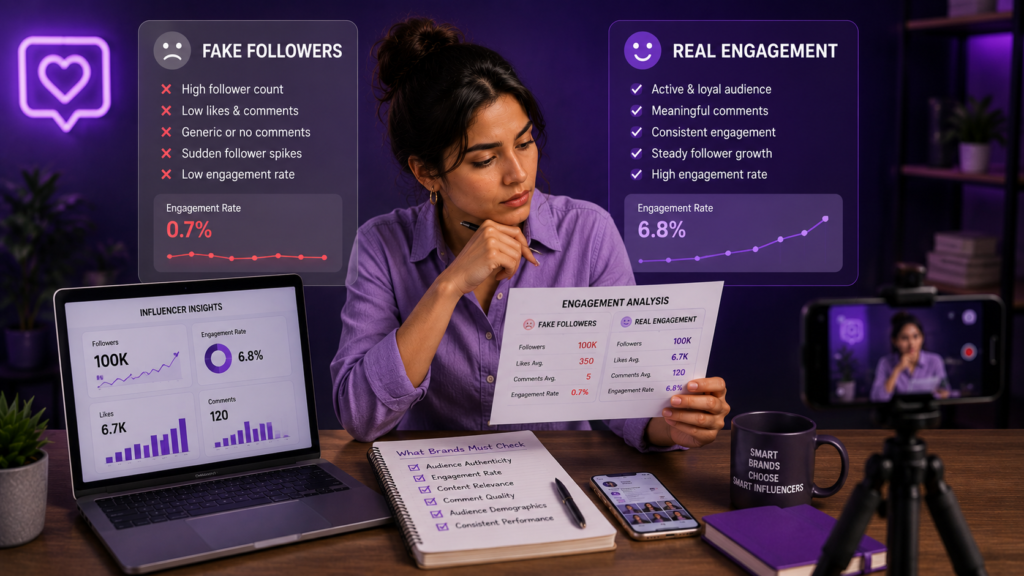
Fake followers can make an influencer look popular.
Real engagement shows whether people actually care.
For brands, this difference is very important. If you choose an influencer only because of follower count, you may end up spending money on fake reach. But if you choose a creator with real engagement, your campaign has a better chance of building trust, getting responses, and creating business impact.
In this blog, we will explain fake followers vs real engagement, why it matters for brands, and what businesses should check before working with influencers.
What Are Fake Followers?
Fake followers are accounts that follow an influencer but do not represent a real, active, or useful audience.
These accounts may be:
- Bot accounts
- Purchased followers
- Spam accounts
- Inactive accounts
- Fake profiles
- Engagement farming accounts
- Irrelevant accounts from unrelated locations
- Accounts created only to increase follower count
Some influencers may buy fake followers to look more popular. Some may use third-party growth services that bring low-quality or bot followers. In other cases, fake followers may come from giveaways, spam activity, or artificial engagement groups.
Whatever the source, fake followers create a false impression of influence.
For example, an influencer may have 200,000 followers, but if most of them are inactive, fake, or irrelevant, the brand is not actually reaching 200,000 potential customers.
That is why follower count alone should never be the main reason to hire an influencer.
What Is Real Engagement?
Real engagement means genuine interaction from a real audience.
It shows that people are not just following the influencer, but also paying attention to their content.
Real engagement can include:
- Meaningful comments
- Saves
- Shares
- Story replies
- Link clicks
- Website visits
- Product questions
- Direct messages
- Poll responses
- Video watch time
- Coupon code usage
- Leads or sales from the campaign
Real engagement is not only about likes. Likes are easy to give and sometimes easy to manipulate. Strong engagement happens when the audience responds with interest, trust, and action.
For example, if an influencer posts about a skincare product and followers ask questions like “Is this suitable for oily skin?” or “Where can I buy this?” that is a sign of real engagement.
If people save the post, share it with friends, click the link, or use a discount code, that is even stronger.
For brands, real engagement is more valuable than fake reach.
Fake Followers vs Real Engagement: Key Difference
The biggest difference is simple:
Fake followers show numbers.
Real engagement shows influence.
A fake follower does not care about the influencer’s content. A real engaged follower listens, responds, asks questions, and may take action.
Here is a simple comparison:
| Point | Fake Followers | Real Engagement |
| Meaning | Fake, inactive, or low-quality accounts | Genuine interaction from real people |
| Value for brands | Low or no value | High value |
| Campaign impact | Poor results | Better awareness, trust, and action |
| Comments | Generic or spammy | Meaningful and topic-related |
| Sales potential | Very low | Higher, if audience matches |
| Trust level | Weak | Strong |
| Brand risk | High | Lower |
| Best signal | Inflated follower count | Quality of audience response |
For brands, real engagement is always more useful than fake follower numbers.
Why Fake Followers Are Dangerous for Brands
Fake followers are not just a small issue. They can directly affect your influencer marketing budget and brand results.
1. Fake Followers Waste Marketing Budget
Brands often pay influencers based on follower count, reach, or popularity.
If a large part of the audience is fake, the brand is paying for people who do not exist as real customers.
Fake followers do not visit websites.
Fake followers do not buy products.
Fake followers do not download apps.
Fake followers do not submit leads.
This means your campaign may look big on paper but deliver very little real business value.
2. Fake Followers Create Misleading Campaign Data
Fake followers can make campaign numbers confusing.
For example, a creator may show a large follower count, but the actual reach, clicks, and conversions may be very low.
This can make it difficult for brands to understand what went wrong.
Was the product wrong?
Was the offer weak?
Was the content poor?
Or was the audience fake?
When the audience is not genuine, campaign data becomes less reliable.
3. Fake Followers Reduce ROI
influence marketing should create some measurable value for the brand.
That value can be awareness, trust, traffic, leads, sales, app downloads, or content assets.
But fake followers reduce the chance of getting these outcomes.
If the campaign reaches fake or inactive accounts, the return on investment becomes weak.
This is why brands should not select influencers only by follower count.
4. Fake Followers Can Hurt Brand Image
When a brand works with low-quality influencers, it can affect brand perception.
People may notice if the collaboration looks fake, forced, or irrelevant. If an influencer promotes too many random products or has suspicious engagement, the audience may not take the brand seriously.
A bad influencer partnership can make a brand look careless.
That is why brands should check audience quality before collaboration.
Why Real Engagement Matters More Than Followers
Real engagement shows that the influencer has an active relationship with their audience.
For brands, this matters because influence is not just about being seen. It is about being trusted.
1. Real Engagement Shows Audience Trust
When followers regularly comment, ask questions, save posts, and respond to stories, it shows that they trust the creator.
Trust is one of the biggest reasons influencer marketing works.
A trusted creator can explain your product in a way that feels more natural than a direct advertisement.
2. Real Engagement Helps Brands Understand Audience Interest
Comments, replies, and shares can show what the audience actually thinks.
For example, if people ask about price, features, availability, or results, it means they are interested.
This helps brands understand whether the product message is working.
3. Real Engagement Can Lead to Better Conversions
Real engagement does not guarantee sales, but it improves the chances of action.
An engaged audience is more likely to:
- Click a link
- Visit a website
- Use a coupon code
- Ask for product details
- Download an app
- Fill out a form
- Buy a product
That is why brands should focus on engagement quality, not just audience size.
4. Real Engagement Builds Long-Term Brand Recall
Even if someone does not buy immediately, meaningful engagement can help build brand recall.
If people see a creator talk about your brand naturally and repeatedly, they may remember your product later.
This is especially useful for categories where customers take time to decide, such as skincare, fitness, SaaS, education, finance, or premium products.
How Brands Can Identify Fake Followers
Brands should check multiple signals before hiring an influencer.
One weak signal does not always mean fake followers. But if you see many warning signs together, you should be careful.
1. Very Low Engagement Compared to Followers
If an influencer has a large following but very few likes, comments, views, or story interactions, the audience may be inactive or fake.
For example, if a creator has 300,000 followers but gets only 500 views on most videos, that is a red flag.
Always check the last 10 to 15 posts instead of judging from one post.
2. Generic Comments
Fake engagement often looks repetitive and shallow.
Examples of low-quality comments:
- Nice
- Great
- Wow
- Amazing
- Super
- Good post
- Only emojis
- Repeated comments from similar accounts
Real comments are usually more specific and related to the content.
For example:
- “Is this available in India?”
- “How much does it cost?”
- “Can you share your experience after 30 days?”
- “Is this good for beginners?”
- “Where can we buy this?”
Comment quality is one of the easiest ways to check real engagement manually.
3. Suspicious Follower Profiles
Open the influencer’s follower list and check random profiles.
Fake accounts often have:
- No profile photo
- Strange usernames
- No posts
- Very few followers
- Following thousands of accounts
- Repeated bio patterns
- Spam links
- Unrelated locations or languages
- No real activity
You do not need to check every follower. But reviewing a sample can help you understand audience quality.
4. Sudden Follower Growth
A sudden increase in followers without any clear reason can be suspicious.
Natural follower growth usually happens over time or after a viral post, media feature, collaboration, or trend.
Suspicious growth may look like:
- Thousands of followers added suddenly
- No increase in likes or comments
- No viral post behind the growth
- Audience quality suddenly changing
- Followers from unrelated countries
Brands can ask creators about major growth spikes if needed.
5. Low Story Views
Story views can reveal how active the audience really is.
An influencer may have 100,000 followers, but if only a very small number of people watch their stories, the real active audience may be much smaller.
Before hiring an influencer, brands can ask for:
- Average story views
- Average reel views
- Average post reach
- Average link clicks
- Average saves and shares
These numbers can give a better picture than follower count alone.
6. Audience Location Mismatch
If your brand sells in India, but the influencer’s audience is mostly from countries where you do not operate, the campaign may not help much.
Audience mismatch does not always mean fake followers, but it can reduce campaign value.
Brands should check:
- Top countries
- Top cities
- Audience language
- Audience age group
- Audience interests
Relevant audience matters more than total audience.
7. Sponsored Posts Perform Poorly
Check the influencer’s past brand collaborations.
If their normal posts get decent engagement but sponsored posts get very low engagement, it may mean their audience does not respond well to promotions.
Also check whether people ask product-related questions on sponsored posts.
If the comments are only generic or unrelated, the collaboration may not create real impact.
How Brands Can Identify Real Engagement
Now let’s look at the positive signals.
1. Meaningful Comments
Real engagement includes comments that are specific, relevant, and human.
Look for comments where people ask questions, share opinions, mention personal experiences, or discuss the product.
This shows that the audience is actually paying attention.
2. Saves and Shares
Saves and shares are strong engagement signals.
People usually save content when they find it useful. They share content when they think someone else should see it.
For brands, saves and shares can be more valuable than likes because they show deeper interest.
3. Story Replies and Poll Responses
If followers reply to stories, vote in polls, answer questions, or react to updates, it shows that the audience is active.
Story engagement can be especially useful because it reflects daily audience connection.
4. Product-Related Questions
When followers ask about price, availability, features, benefits, size, usage, results, or buying links, it shows purchase interest.
This is one of the strongest signals for brands.
5. Consistent Engagement Over Time
Real engagement usually stays consistent across posts.
There may be ups and downs, but the overall pattern looks natural.
If an influencer gets engagement only on a few posts and almost nothing on others, brands should check deeper.
6. Audience Trust
Audience trust is visible in how followers talk to the creator.
If followers ask for recommendations, seek advice, respond to opinions, and discuss topics seriously, it shows the creator has influence.
This trust is what brands should look for.
Engagement Rate Is Important, But Not Enough
Engagement rate is useful, but brands should not depend only on one number.
A high engagement rate can also be manipulated through engagement groups, giveaways, or fake comments.
A low engagement rate can happen because of platform algorithm changes, content format, or niche behavior.
So instead of depending only on engagement rate, brands should check:
- Engagement quality
- Comment relevance
- Audience location
- Story views
- Content consistency
- Follower authenticity
- Sponsored post performance
- Creator professionalism
The best influencer evaluation combines data and human review.
What Is Better: More Followers or Better Engagement?
For most brands, better engagement is more valuable than more followers.
A creator with 25,000 real and engaged followers can be more useful than a creator with 250,000 followers but weak audience quality.
However, the answer also depends on your campaign goal.
If your goal is mass awareness, reach matters.
If your goal is leads or sales, engagement quality matters more.
If your goal is local promotion, audience location matters more.
If your goal is product education, content quality matters more.
If your goal is trust-building, creator-audience relationship matters more.
So, brands should not choose between followers and engagement blindly.
They should choose based on campaign goals.
What Brands Should Ask Before Hiring an influence
Before finalizing any influencer, brands should ask these questions:
- Is the audience relevant to our product?
- Are the comments meaningful or generic?
- Does the engagement look natural?
- Are the followers real and active?
- Does the creator have strong story views?
- Do sponsored posts perform well?
- Is the audience location useful for our brand?
- Does the creator’s content match our brand?
- Can the influencer share audience insights?
- Can we track campaign performance?
These questions help brands avoid fake popularity and focus on real influence.
How to Measure Real influence Performance
After the campaign goes live, brands should track performance properly.
Important metrics include:
- Reach
- Impressions
- Engagement rate
- Saves
- Shares
- Story views
- Link clicks
- Website visits
- Leads
- Sales
- Coupon code usage
- App downloads
- Cost per result
- Return on investment
The right metric depends on your campaign goal.
For awareness, track reach and impressions.
For engagement, track comments, saves, shares, and replies.
For traffic, track link clicks and website visits.
For sales, track coupon codes, revenue, and conversions.
For leads, track form submissions and inquiries.
This helps brands understand which influencers are actually useful.
Common Mistakes Brands Should Avoid
Many brands lose money in influencer marketing because they focus on the wrong signals.
Avoid these mistakes:
1. Choosing Only by Follower Count
A large follower count does not guarantee real influence.
2. Ignoring Comment Quality
Comments can reveal whether the audience is genuine or fake.
3. Not Checking Audience Location
If the audience is not in your target market, the campaign may not work.
4. Not Asking for Insights
Brands should ask for audience and performance insights before collaboration.
5. Ignoring Sponsored Post Performance
A creator’s regular content may perform well, but brand posts may perform poorly.
6. Not Tracking Results
Without tracking, you cannot know whether the campaign delivered value.
7. Expecting Instant Sales From Every influence
influence marketing can support awareness, trust, traffic, leads, and sales. But every campaign should be judged according to its goal.
Fake Followers vs Real Engagement: Final Checklist for Brands
Before hiring an influencer, use this quick checklist:
- Check follower count, but do not depend only on it.
- Review the last 10 to 15 posts.
- Read comments manually.
- Look for meaningful audience interaction.
- Check average views and story views.
- Ask for audience insights.
- Verify top countries and cities.
- Check past sponsored posts.
- Look for sudden follower growth.
- Review random follower profiles.
- Track campaign performance after posting.
If the influencer has a real, active, and relevant audience, they may be a good fit for your brand.
How Influnets Can Help Brands Find Genuine Creators
Finding the right influencer manually can take time.
Brands need to search profiles, check engagement, verify audience quality, compare creators, message influencers, discuss pricing, and manage campaign details.
Influnets aims to make this process easier by helping brands discover and connect with relevant creators for their campaigns.
With Influnets, brands can move beyond follower count and focus on creators who match their category, audience, campaign goals, and collaboration needs.
For brands, influencer marketing should not be about fake popularity.
It should be about real creators, real engagement, and real business impact.
Conclusion
Fake followers and real engagement are not the same.
Fake followers can make an influencer look popular, but they do not create real value for brands. Real engagement shows that people are paying attention, interacting with the creator, and possibly taking action.
Before hiring an influencer, brands should check more than follower count. They should review engagement quality, comments, story views, audience location, follower authenticity, sponsored post performance, and campaign tracking options.
In influencer marketing, real influence is not measured only by how many people follow a creator.
It is measured by how many people trust, listen, respond, and act.
For brands, that is what truly matters.
FAQs
What is the difference between fake followers and real engagement?
Fake followers are inactive, bot, purchased, or low-quality accounts that increase follower count but do not create real value. Real engagement means genuine interactions like meaningful comments, saves, shares, story replies, clicks, leads, or sales from real audience members.
Why are fake followers bad for brands?
Fake followers are bad because they do not buy products, visit websites, download apps, generate leads, or create real brand awareness. They can make brands waste money on fake reach.
How can brands check real engagement?
Brands can check real engagement by reviewing comment quality, saves, shares, story views, product-related questions, audience insights, link clicks, and past sponsored post performance.
Is follower count important in influencer marketing?
Follower count is useful, but it should not be the only factor. Brands should also check audience relevance, engagement quality, fake followers, content style, and campaign goals.
What are signs of fake engagement?
Signs of fake engagement include generic comments, repeated emoji comments, suspicious profiles, sudden follower growth, low story views, low video views, and audience location mismatch.
What is more important: followers or engagement?
Engagement is usually more important than followers because it shows whether the audience is active and interested. However, the best choice depends on the campaign goal.
Can influencers with fake followers still have real engagement?
Some influencers may have a mix of real and fake followers. Brands should check whether the influencer has enough real, active, and relevant audience before collaborating.
How can Influnets help brands with influencer selection?
Influnets helps brands discover and connect with relevant creators, making it easier to choose influencers based on category, audience fit, and collaboration goals instead of only follower count.