Many brands make the same mistake when choosing influencers.
They open an influencer’s profile, check the follower count, and assume that more followers mean better results.
But influencer marketing does not work like that.
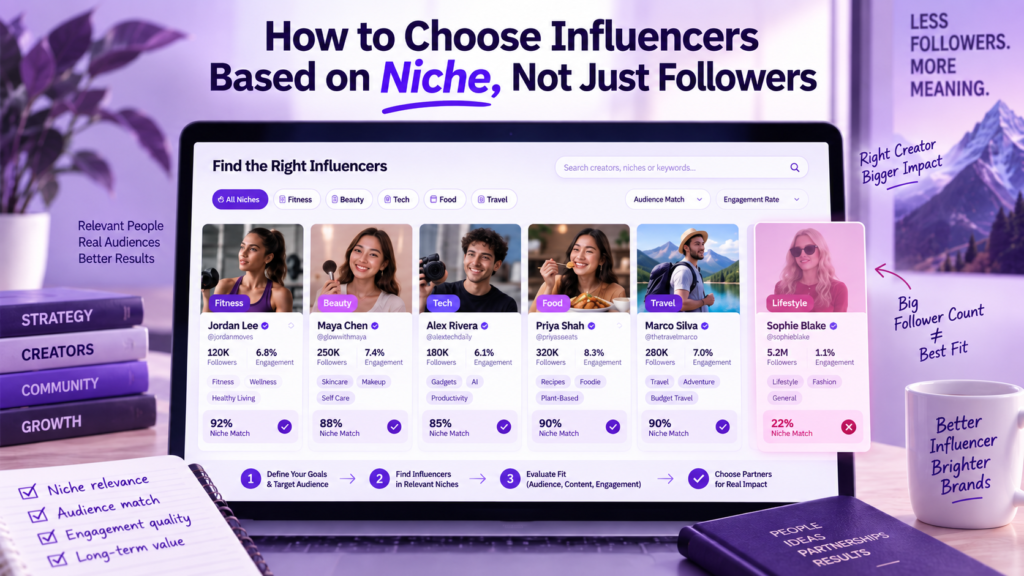
A creator with 5 lakh followers may not be useful for your brand if their audience is not interested in your product. At the same time, a niche creator with 15,000 engaged followers can sometimes bring better awareness, trust, leads, or sales.
That is because influencer marketing is not only about reach.
It is about relevance.
The right influencer is not always the biggest influencer. The right influencer is the one whose content, audience, niche, and trust match your brand.
For example, if you sell skincare products, a beauty creator with 20,000 genuine followers can be more valuable than a comedy creator with 2 lakh followers. If you run a SaaS tool for businesses, a LinkedIn creator with a small but relevant business audience can be more useful than a lifestyle influencer with a larger but unrelated audience.
In this blog, we will explain how brands can choose influencers based on niche, not just followers, and why niche relevance is one of the most important factors in influencer marketing.
What Does Influencer Niche Mean?
An influencer niche is the main topic, category, or interest area around which a creator builds their content and audience.
A niche tells you what kind of people follow the creator and why they follow them.
Common influencer niches include:
- Beauty
- Skincare
- Fashion
- Fitness
- Food
- Travel
- Technology
- Finance
- Parenting
- Education
- Gaming
- Business
- Career
- Health and wellness
- Lifestyle
- Home decor
- Automobile
- Real estate
- Local city content
- SaaS and startup content
For example, a fitness influencer creates content about workouts, gym routines, nutrition, transformation, and healthy habits. Their audience likely follows them because they care about fitness.
A finance creator creates content about money, saving, investing, credit cards, tax, or personal finance. Their audience follows them because they want financial knowledge.
A food creator shares restaurant reviews, recipes, street food, or café recommendations. Their audience follows them because they love food.
When a brand chooses an influencer from the right niche, the brand message feels more natural and relevant.
Why Niche Matters More Than Follower Count
Follower count tells you how many people follow a creator.
Niche tells you whether those people are likely to care about your brand.
This is the real difference.
A large follower count can give visibility, but visibility is not always useful if the audience is wrong.
For example:
A baby care brand working with a parenting creator can reach parents directly.
A gym working with a fitness creator can reach people interested in workouts.
A SaaS brand working with a business creator can reach professionals and founders.
A local café working with a city food creator can reach nearby food lovers.
In each case, niche relevance makes the campaign stronger.
If the niche is wrong, the campaign may get views but not meaningful results.
This is why brands should ask:
“Does this influencer’s audience match our target customer?”
Not only:
“How many followers do they have?”
Follower Count vs Niche Relevance: Simple Difference
| Factor | Follower Count | Niche Relevance |
| What it shows | Audience size | Audience fit |
| Main value | Reach | Relevance and trust |
| Risk | Irrelevant visibility | Smaller but focused reach |
| Best for | Large awareness | Targeted campaigns |
| Brand question | How many people follow them? | Are these people our customers? |
| Campaign impact | Can create visibility | Can create better action |
Follower count is not useless. It has value. But it should never be the only selection factor.
The best influencer choice comes from a balance of niche, audience quality, engagement, content style, and campaign goal.
Why Brands Should Choose Influencers by Niche
1. Niche Influencers Reach the Right Audience
A niche influencer already has an audience interested in a specific topic.
This helps brands reach people who are more likely to care about the product.
For example:
A skincare brand should reach people interested in skincare.
A fitness app should reach people interested in workouts.
A food product should reach people interested in food.
A business tool should reach founders, marketers, or professionals.
When the audience is already interested in the category, the campaign has a better chance of getting attention.
2. Niche Creators Build Stronger Trust
People follow niche creators because they trust their knowledge, taste, experience, or recommendations in that specific category.
For example, if a tech creator recommends a productivity app, the audience may take it seriously because they already trust that creator for technology-related content.
If a beauty creator reviews a moisturizer, followers may ask product-related questions because they trust the creator’s skincare opinions.
This niche trust can make brand recommendations more believable.
3. Content Feels More Natural
When a brand matches the creator’s niche, the content does not feel forced.
For example:
A gym product in a fitness creator’s reel feels natural.
A café review on a food creator’s page feels natural.
A learning app on an education creator’s channel feels natural.
A business tool on a startup creator’s LinkedIn profile feels natural.
But if a completely unrelated creator promotes the same product, the audience may ignore it or feel the post is only for money.
Niche fit makes influencer marketing feel more authentic.
4. Better Engagement Quality
Niche creators often receive more meaningful engagement because their followers care about the topic.
Good engagement may include:
- Product-related questions
- Buying interest
- Personal experiences
- Saves
- Shares
- Comments about usage
- Audience discussions
- Story replies
- Link clicks
For example, if a finance creator talks about a budgeting app, followers may ask serious questions about features, pricing, or safety.
That type of engagement is more valuable than generic comments like “Nice” or “Great.”
5. Higher Chance of Conversions
A relevant audience is more likely to take action.
Conversions can include:
- Website visits
- Leads
- Sales
- App downloads
- Demo bookings
- Store visits
- Trial signups
- Course enrollments
- WhatsApp inquiries
If the influencer’s audience already has interest in your category, they are more likely to click, inquire, or buy.
Niche relevance does not guarantee sales, but it improves the chances of meaningful results.
How to Choose Influencers Based on Niche
1. Define Your Brand Category Clearly
Before choosing influencers, first define your own brand category.
Ask:
What do we sell?
Who is it for?
What problem does it solve?
Which audience needs it?
Which content category matches our product?
For example:
If you are a skincare brand, your category is beauty, skincare, self-care, lifestyle, or wellness.
If you are a SaaS brand, your category may be business, productivity, marketing, sales, startups, or technology.
If you are a café, your category is food, local lifestyle, city exploration, or hospitality.
Once your brand category is clear, influencer selection becomes easier.
2. Understand Your Target Audience
The right niche depends on your target audience.
You should know:
- Age group
- Location
- Gender, if relevant
- Language
- Interests
- Buying behavior
- Pain points
- Platform preference
- Content consumption habits
For example, if your target audience is working professionals in India, LinkedIn creators or productivity creators may be useful.
If your target audience is college students, Instagram, YouTube Shorts, student creators, and campus influencers may work better.
If your target audience is young mothers, parenting and family lifestyle creators may be more relevant.
Choose influencers based on where your audience spends time and whom they trust.
3. Match Product Use Case With Creator Content
A good influencer match happens when your product fits naturally into the creator’s content.
Ask:
Can this creator show our product naturally?
Can they explain our product clearly?
Will their audience understand why this product matters?
Does the product fit their usual content style?
For example:
A kitchen appliance fits naturally with food creators, home creators, and cooking creators.
A study app fits naturally with education creators, student creators, productivity creators, and career creators.
A skincare product fits naturally with beauty, skincare, wellness, and lifestyle creators.
If the product does not fit naturally, the campaign may feel forced.
4. Check Audience Relevance, Not Just Creator Category
Sometimes, a creator’s niche may look relevant, but their audience may not match your target customer.
For example, a fashion creator may have followers from many countries, but your brand may sell only in India.
A business creator may have many students following them, but your product may be for enterprise founders.
A fitness creator may focus on bodybuilding, but your product may be for beginners.
So, do not only check the creator’s category. Check their audience details too.
Ask for:
- Top countries
- Top cities
- Audience age group
- Audience interests
- Audience gender split, if relevant
- Average reach
- Story views
- Engagement rate
Audience relevance is the real test of niche fit.
5. Review the Creator’s Recent Content
Before selecting any influencer, review their recent content.
Check the last 10 to 15 posts or videos.
Look for:
- Main content topics
- Posting consistency
- Content quality
- Audience response
- Sponsored posts
- Comment quality
- Content tone
- Brand safety
- Product explanation ability
- Engagement pattern
This helps you understand whether the creator is truly active in that niche.
Some creators may mention a niche in their bio but post random content. That can reduce campaign relevance.
6. Check Comment Quality
Comments can reveal whether the audience is genuinely interested in the niche.
For example, a beauty creator’s comment section may include questions like:
“Is this good for oily skin?”
“Can I use this daily?”
“Where did you buy this?”
“Is it safe for sensitive skin?”
These comments show niche interest.
A tech creator’s comments may include:
“Does this work on Android?”
“Is this tool free?”
“Can startups use this?”
“How does this compare with another app?”
These comments show relevant audience engagement.
If comments are mostly generic, fake, or unrelated, the creator may not have strong niche influence.
7. Look at Past Brand Collaborations
Past collaborations can show whether the creator has worked with similar brands.
Check:
- Which brands they promoted
- Whether the content felt natural
- How the audience responded
- Whether people asked product questions
- Whether sponsored posts performed well
- Whether they promoted competitors
- Whether they promote too many random brands
If the creator has done good collaborations in your category, that can be a positive sign.
But be careful if they promote too many unrelated products. That may reduce audience trust.
8. Choose the Right Platform for the Niche
Different niches perform better on different platforms.
Good for:
- Fashion
- Beauty
- Food
- Fitness
- Travel
- Lifestyle
- Local businesses
- D2C brands
- Short-form content
YouTube
Good for:
- Tech
- Education
- Product reviews
- Tutorials
- Finance
- Gaming
- Long-form trust
- Detailed explanations
Good for:
- B2B
- SaaS
- Business
- Startups
- Career
- Marketing
- Sales
- Professional services
Good for:
- Regional communities
- Local businesses
- Parenting
- Older audience groups
- Community-based marketing
The right platform depends on where your niche audience is active.
Examples of Choosing Influencers by Niche
Example 1: Skincare Brand
Best influencer niches:
- Beauty creators
- Skincare educators
- Self-care creators
- Lifestyle creators
- Dermatology-focused creators
- UGC creators
Why?
The audience already cares about skincare and product recommendations.
Example 2: SaaS Brand
Best influencer niches:
- Business creators
- Startup creators
- Marketing creators
- Productivity creators
- LinkedIn creators
- Tech reviewers
Why?
The audience may include founders, marketers, business owners, and professionals.
Example 3: Local Café
Best influencer niches:
- Food bloggers
- Local city creators
- Lifestyle creators
- Travel/city explorers
Why?
The audience is more likely to visit the café if they are local and interested in food.
Example 4: Fitness App
Best influencer niches:
- Fitness creators
- Gym creators
- Health creators
- Weight loss creators
- Home workout creators
- Wellness creators
Why?
The audience already cares about health and exercise.
Example 5: EdTech Platform
Best influencer niches:
- Education creators
- Student creators
- Career creators
- Exam preparation creators
- Productivity creators
Why?
The audience includes students, job seekers, parents, or learners.
Niche Influencer Selection Checklist for Brands
Before finalizing an influencer, use this checklist:
- Does the creator’s niche match our product category?
- Does their audience match our target customer?
- Is their content style suitable for our brand?
- Do they get meaningful comments from their audience?
- Is their engagement genuine?
- Is their audience location relevant?
- Can they explain our product naturally?
- Have they worked with similar brands before?
- Do they promote too many unrelated products?
- Are their followers real and active?
- Is their platform right for our campaign goal?
- Can we track performance with links or codes?
If the answer is yes to most of these questions, the influencer may be a strong niche fit.
Common Mistakes Brands Make While Choosing Influencers
1. Choosing Only by Follower Count
High followers do not guarantee results. Audience relevance matters more.
2. Ignoring Niche Fit
If the creator’s content category does not match your brand, the promotion may feel forced.
3. Not Checking Audience Location
A creator may have good content but an audience outside your target market.
4. Ignoring Comment Quality
Comments show whether the audience is genuinely interested.
5. Choosing a Creator Because They Are Trending
A trending creator may not always be right for your brand.
6. Not Reviewing Past Collaborations
Past sponsored content can show how the creator handles brand promotions.
7. Not Giving a Clear Brief
Even the right niche creator needs a clear campaign brief.
8. Not Tracking Results
Use UTM links, coupon codes, landing pages, or affiliate links to measure performance.
Should Brands Ever Choose Big Influencers?
Yes, big influencers can be useful.
Macro influencers or celebrity creators can help with:
- Mass awareness
- Product launches
- Brand visibility
- Large campaigns
- Regional or national reach
But even with big influencers, niche fit still matters.
For example, a large beauty influencer is still more relevant for a skincare brand than a large comedy creator, unless the campaign idea specifically needs entertainment.
The bigger the influencer, the more carefully brands should check audience relevance, pricing, content fit, and campaign goal.
Reach without relevance can waste budget.
Best Strategy: Combine Niche Creators With Scale
Brands can use a mix of creators.
For example, a D2C brand can work with:
- 1 macro creator for awareness
- 10 micro creators for niche trust
- 30 nano creators for authentic reviews
- 5 UGC creators for ad content
This creates a stronger campaign.
The macro creator gives reach.
The micro creators build niche credibility.
The nano creators create social proof.
The UGC creators create reusable content.
This approach is often better than spending the full budget on one large influencer.
How Influnets Can Help Brands Find Niche Influencers
Finding niche influencers manually can take a lot of time.
Brands have to search profiles, check content, verify audience, compare engagement, message creators, discuss pricing, and manage campaign details.
Influnets helps brands discover and connect with relevant creators for influencer campaigns.
With Influnets, brands can make creator discovery more organized by exploring creators based on category, campaign needs, collaboration type, and audience fit.
For brands, the goal should not be to find the biggest creator.
The goal should be to find the most relevant creator.
When brands choose influencers based on niche, they can build more meaningful campaigns and reach audiences that actually care.
Conclusion
Choosing influencers based only on followers is one of the biggest mistakes brands can make.
Follower count shows audience size, but niche shows audience relevance.
A creator with a smaller but highly relevant audience can often bring better trust, engagement, and conversions than a larger creator with an unrelated audience.
Brands should choose influencers based on niche, audience fit, content quality, engagement quality, platform, past collaborations, and campaign goal.
The right influencer is not the one with the biggest numbers.
The right influencer is the one whose audience is most likely to care about your brand.
In influencer marketing, relevance beats random reach.
If your brand wants better results, start choosing creators by niche — not just followers.
FAQs
Why should brands choose influencers based on niche?
Brands should choose influencers based on niche because niche creators have audiences that are already interested in specific topics. This makes the campaign more relevant, natural, and likely to get meaningful engagement.
Is follower count important in influencer marketing?
Follower count is important, but it should not be the only factor. Brands should also check niche relevance, audience quality, engagement rate, content fit, and campaign goal.
What is a niche influencer?
A niche influencer is a creator who focuses on a specific topic, category, or interest area, such as beauty, fitness, food, finance, parenting, technology, education, or business.
How do I know if an influencer’s niche matches my brand?
An influencer’s niche matches your brand if their content category, audience interests, platform, tone, and engagement align with your product, target customers, and campaign goal.
Are niche influencers better than big influencers?
Niche influencers can be better for targeted campaigns, trust, engagement, and conversions. Big influencers can be better for mass awareness and large-scale visibility. The best choice depends on the campaign objective.
What should brands check before choosing a niche influencer?
Brands should check audience relevance, engagement quality, comment quality, content style, follower authenticity, audience location, past collaborations, brand fit, and platform performance.
Can small niche influencers generate sales?
Yes, small niche influencers can generate sales if their audience is genuine, engaged, relevant, and interested in the brand’s product category.
How can Influnets help brands find niche influencers?
Influnets helps brands discover and connect with relevant creators based on category, campaign needs, and collaboration goals, making niche influencer discovery more organized and easier.