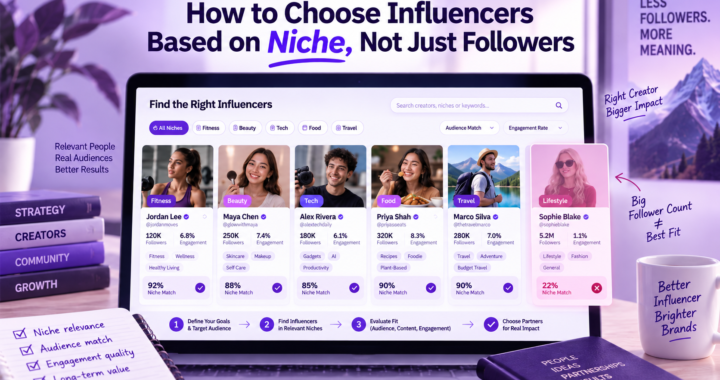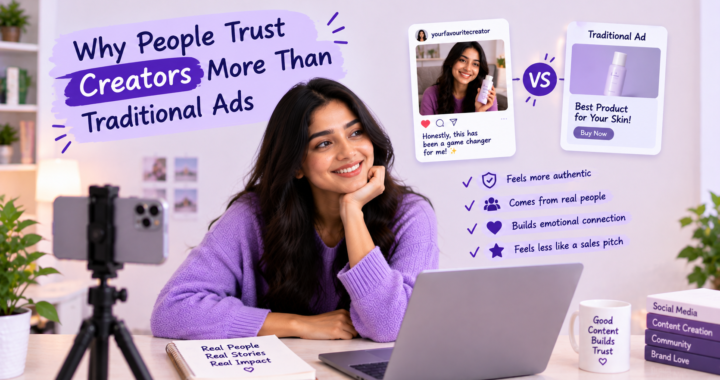
Influencer marketing is not just about working with famous people. It is about choosing the right creator who can connect your brand with the right audience.
Many brands, especially new businesses and startups, make one common mistake: they choose influencers only by follower count.
They think a creator with more followers will automatically bring better results.
But that is not always true.
A nano influencer with a small but loyal audience can sometimes bring better engagement than a macro influencer with a huge but less connected audience. Similarly, a macro influencer can be useful when your brand needs large-scale awareness. A micro influencer can be a good balance between reach, trust, and budget.
So, the real question is not “Which influencer has more followers?”
The real question is: “Which type of influencer is right for my brand goal?”
In this blog, we will understand the difference between nano, micro, and macro influencers, their benefits, limitations, and how your brand can choose the right one.
What Are Nano, Micro, and Macro Influencers?
Influencers are often grouped based on their audience size. Different platforms and agencies may define these categories slightly differently, but the basic idea remains the same.
Nano Influencers
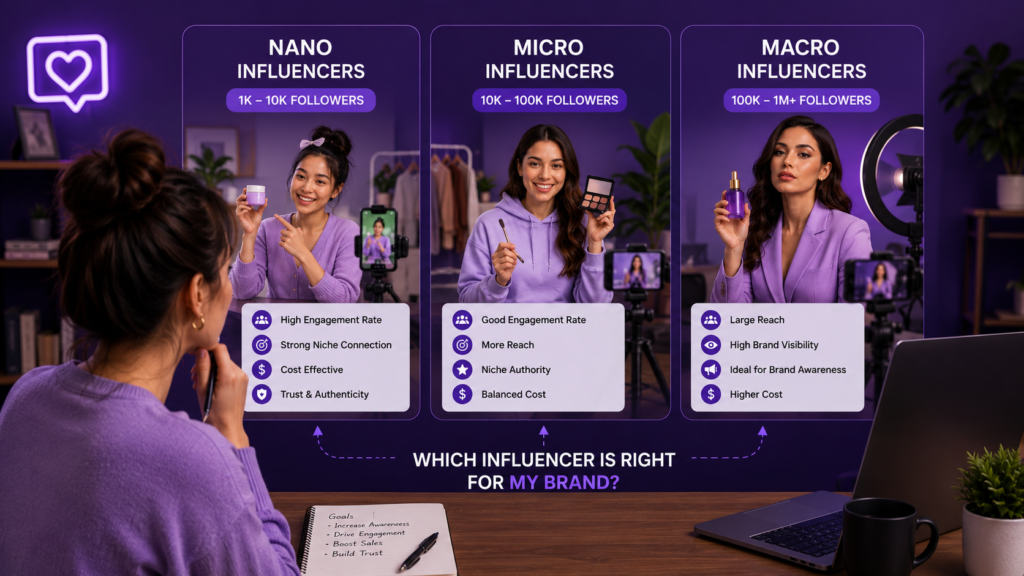
Nano influencers are creators with a smaller audience, usually between 1,000 to 10,000 followers.
They may not have massive reach, but they often have a strong personal connection with their audience.
Their followers usually see them as relatable, honest, and approachable.
Nano influencers are useful for brands that want trust, local reach, niche audiences, and authentic recommendations.
Micro Influencers
Micro influencers usually have around 10,000 to 100,000 followers.
They have a larger audience than nano influencers but still maintain good engagement and niche relevance.
Micro influencers are often considered a strong choice for brands because they offer a good balance between reach, trust, and affordability.
They are useful for product promotions, D2C campaigns, app promotions, service awareness, and niche marketing.
Macro Influencers
Macro influencers usually have around 100,000 to 1 million followers.
They have a larger audience and stronger visibility than nano and micro influencers.
Macro influencers are useful when a brand wants broad awareness, faster reach, product launch visibility, or large-scale campaign exposure.
However, they usually cost more and may have lower personal interaction with followers compared to smaller creators.
Quick Comparison: Nano vs Micro vs Macro Influencers
| Influencer Type | Follower Range | Best For | Main Strength | Main Limitation |
| Nano Influencer | 1K–10K | Local campaigns, niche trust, low-budget campaigns | Strong personal connection | Limited reach |
| Micro Influencer | 10K–100K | D2C brands, startups, product promotions | Balance of reach and trust | Needs proper shortlisting |
| Macro Influencer | 100K–1M | Brand awareness, launches, mass reach | Large audience reach | Higher cost and lower personal connection |
This comparison makes one thing clear: every influencer type has a different role.
Nano influencers are not “too small.”
Micro influencers are not “average.”
Macro influencers are not always “better.”
The best choice depends on your brand goal.
Nano Influencers: Meaning, Benefits, and Best Use Cases
Nano influencers are creators with a smaller but highly connected audience.
They may be students, working professionals, local creators, niche educators, mom bloggers, fitness enthusiasts, food reviewers, or community-based creators.
Their audience may not be huge, but it is often more personal.
Benefits of Nano Influencers
1. Higher Trust
Nano influencers usually have a close relationship with their followers. Their audience may know them personally or feel connected to their daily life.
Because of this, their recommendations can feel more genuine.
For example, if a local food creator recommends a café in their city, their audience may trust that suggestion more than a large celebrity post.
2. More Affordable
Nano influencers are usually more budget-friendly than larger influencers.
This makes them useful for startups, small businesses, local brands, and new D2C brands that want to test influencer marketing without spending a large budget.
3. Strong Local or Niche Reach
Nano influencers are useful when your brand wants to target a specific location or niche.
For example:
- A café in Noida can work with local food creators.
- A fitness studio can work with local fitness creators.
- A handmade jewellery brand can work with fashion creators from a specific audience group.
- A coaching institute can work with student creators.
4. Authentic Content
Nano influencers often create content that feels natural and less polished.
For some brands, this can be a benefit because the content feels more real and relatable.
Limitations of Nano Influencers
Nano influencers also have some limitations:
- Limited reach
- Less professional experience
- May need more guidance
- Smaller content production capability
- Campaign management can take time if you work with many nano creators
When Should Brands Choose Nano Influencers?
Choose nano influencers when your brand wants:
- Local awareness
- Community-level trust
- Low-budget testing
- Niche targeting
- Real product feedback
- Authentic user-generated content
- Small campaign experiments
Nano influencers are a good choice when trust matters more than mass reach.
Micro Influencers: Meaning, Benefits, and Best Use Cases
Micro influencers are creators with a mid-size audience.
They are usually more experienced than nano influencers and more affordable than macro influencers.
This makes them a strong choice for many brands.
Benefits of Micro Influencers
1. Good Balance of Reach and Trust
Micro influencers usually have enough audience size to create visibility, but they are still connected enough to maintain trust.
This balance makes them useful for brands that want both awareness and engagement.
2. Strong Niche Authority
Many micro influencers are known for a specific niche, such as beauty, fitness, finance, parenting, technology, food, education, or travel.
Their audience follows them because they care about that topic.
For example, a skincare brand can work with micro beauty creators. A productivity app can work with student or business creators. A fintech app can work with finance educators.
3. Better Campaign Fit for Growing Brands
Micro influencers are often suitable for startups, D2C brands, SaaS companies, app-based businesses, local businesses, and service brands.
They can create product reviews, tutorials, reels, testimonials, comparison content, and educational content.
4. More Professional Than Nano Influencers
Many micro influencers have already worked with brands before. They may understand briefs, deadlines, deliverables, content approval, and reporting better.
This can make collaboration easier for brands.
Limitations of Micro Influencers
Micro influencers also have some limitations:
- Pricing can vary a lot
- Some may have fake engagement
- Not all micro creators have strong conversion power
- Brands still need to check audience quality
- Multiple creators may be required for larger reach
When Should Brands Choose Micro Influencers?
Choose micro influencers when your brand wants:
- Product promotion
- Niche audience reach
- Better engagement
- Balanced budget
- Trust-based marketing
- UGC content
- App downloads
- Lead generation
- Campaign testing before scaling
Micro influencers are often the best starting point for brands that want practical results without spending too much.
Macro Influencers: Meaning, Benefits, and Best Use Cases
Macro influencers have a large audience and strong visibility.
They may be popular creators, entertainers, educators, vloggers, industry personalities, or social media celebrities.
Brands usually work with macro influencers when they want bigger reach and faster awareness.
Benefits of Macro Influencers
1. Large-Scale Reach
Macro influencers can introduce your brand to a large audience quickly.
This is useful for product launches, big campaigns, festive promotions, app launches, and national-level awareness.
2. Strong Brand Visibility
When a macro influencer talks about your brand, it can make your brand look more visible and established.
This can be useful for newer brands that want to build recognition quickly.
3. Professional Content Quality
Many macro influencers have better production quality, content teams, editing support, and campaign experience.
They can create high-quality videos, reels, integrations, reviews, and branded content.
4. Useful for Top-of-Funnel Marketing
Macro influencers are strong for top-of-funnel marketing.
This means they are good for:
- Awareness
- Reach
- Visibility
- Product launch buzz
- Brand recall
- Large audience exposure
Limitations of Macro Influencers
Macro influencers also have limitations:
- Higher cost
- Lower personal interaction with followers
- Less niche-specific audience sometimes
- May promote many brands
- Campaigns may feel less personal
- Not always suitable for direct sales
A macro influencer may give your brand reach, but reach does not always guarantee conversions.
When Should Brands Choose Macro Influencers?
Choose macro influencers when your brand wants:
- Large awareness
- Product launch visibility
- National or regional reach
- Big campaign exposure
- Premium brand positioning
- Fast visibility
- Large-scale content impact
Macro influencers are useful when reach matters more than deep personal engagement.
Which Influencer Type Is Best for Your Brand?
There is no one-size-fits-all answer.
The best influencer type depends on your campaign goal, budget, product category, target audience, and expected results.
Here is a simple decision guide.
Choose Nano Influencers If:
- You have a small budget
- You want local reach
- You want authentic content
- You are testing influencer marketing for the first time
- You want community-level trust
- You want creators from a specific city or niche
- You want product feedback from real users
Choose Micro Influencers If:
- You want a balance between reach and trust
- You want niche audience targeting
- You want product promotion
- You want better engagement
- You are a startup or growing brand
- You want to run a performance-focused campaign
- You want creators who can explain your product properly
Choose Macro Influencers If:
- You want mass awareness
- You have a larger budget
- You are launching a new product
- You want brand visibility at scale
- You want regional or national-level exposure
- You want high-quality creator content
- You want fast reach
Nano vs Micro vs Macro Influencers Based on Campaign Goals
For Brand Awareness
Macro influencers can work well because they have large reach.
But brands can also use multiple micro influencers together to create repeated visibility among niche audiences.
For Sales and Conversions
Micro influencers often perform better because their audience is more targeted and trust-based.
Nano influencers can also work well for local or community-based sales.
For Local Business Promotion
Nano influencers are usually the best choice because they have local relevance and personal connection.
For example, cafés, salons, gyms, coaching centers, clinics, and local events can benefit from nano creators.
For Product Launch
Macro influencers can create buzz, while micro influencers can explain the product better.
A mixed strategy can work well here.
For User-Generated Content
Nano and micro influencers are often useful because they can create authentic product content at a more affordable cost.
For Niche Marketing
Micro influencers are often the best choice because they have niche-specific audiences and better content maturity.
Best Strategy: Don’t Choose Only One Type
Many successful brands do not depend on only one influencer type.
They use a mix of nano, micro, and macro influencers depending on the campaign goal.
For example, a skincare brand may use:
- 1 macro influencer for awareness
- 10 micro influencers for product education
- 50 nano influencers for authentic reviews and local reach
This creates a full influencer marketing funnel.
The macro influencer creates visibility.
The micro influencers build trust and explain the product.
The nano influencers create relatability and social proof.
This mixed approach can help brands get both reach and credibility.
Common Mistakes Brands Make While Choosing Influencer Type
Many brands do not get good results from influencer marketing because they choose the wrong influencer type.
Here are some common mistakes:
1. Choosing Only by Follower Count
More followers do not always mean better results. Audience relevance matters more.
2. Ignoring Engagement Quality
Likes and comments should be genuine. Fake engagement can waste your budget.
3. Not Matching Influencer Type With Campaign Goal
If your goal is local sales, a macro influencer may not be the best option. If your goal is mass awareness, one nano influencer may not be enough.
4. Not Checking Audience Location
If your brand sells only in India, but the influencer’s audience is mostly outside India, the campaign may not work.
5. Not Giving Clear Briefs
Even the right influencer needs a clear campaign brief to create effective content.
6. Expecting Instant Sales From Every Campaign
Influencer marketing can support awareness, trust, traffic, and sales. But not every campaign will immediately generate direct revenue.
7. Not Tracking Results
Brands should track reach, engagement, clicks, leads, sales, coupon code usage, and campaign ROI.
How to Decide Your Influencer Marketing Budget
Your influencer budget should depend on your campaign goal.
If you are testing influencer marketing for the first time, start small.
You can begin with nano and micro influencers, test different content styles, and then scale what works.
For example:
- Small local campaign: Nano influencers
- Startup product awareness: Micro influencers
- New product launch: Micro + macro influencers
- Large brand campaign: Macro + multiple micro influencers
- UGC campaign: Nano + micro influencers
Do not spend your full budget on one influencer unless you are very sure about their audience, content quality, and performance history.
A better approach is to test, measure, and then scale.
What Should Brands Check Before Finalizing Any Influencer?
Whether you choose nano, micro, or macro influencers, always check these points:
- Audience relevance
- Engagement quality
- Content quality
- Audience location
- Fake followers
- Previous brand collaborations
- Comment quality
- Posting consistency
- Brand fit
- Pricing
- Deliverables
- Timeline
- Usage rights
- Reporting process
Influencer selection should be based on both creativity and data.
A good creator should not only look popular. They should also be relevant, authentic, and suitable for your brand.
Example: Which Influencer Type Should Different Brands Choose?
Example 1: Local Café
A local café in Delhi wants more footfall.
Best choice: Nano influencers and local food creators.
Why? Because local creators can reach people nearby who may actually visit the café.
Example 2: D2C Skincare Brand
A skincare brand wants awareness and product trials.
Best choice: Micro influencers and selected nano influencers.
Why? Because beauty and skincare creators can explain the product, show results, and create relatable content.
Example 3: New Mobile App
A mobile app wants downloads across India.
Best choice: Micro influencers for targeted promotion and macro influencers for larger awareness.
Why? Because the app needs both reach and explanation.
Example 4: B2B SaaS Company
A SaaS company wants leads from business owners.
Best choice: Micro creators on LinkedIn, YouTube, or business communities.
Why? Because B2B decisions need trust, education, and relevance.
Example 5: Large Fashion Brand
A fashion brand is launching a new collection.
Best choice: Macro influencers for visibility and micro influencers for niche audience engagement.
Why? Because fashion campaigns need both reach and style-based influence.
Final Decision Framework for Brands
To choose between nano, micro, and macro influencers, ask these questions:
1. What is my campaign goal?
Awareness, sales, leads, content, app downloads, or product launch?
2. Who is my target audience?
Age, location, interests, language, income level, and buying behavior.
3. What is my budget?
Small, medium, or large?
4. What type of trust do I need?
Personal trust, niche trust, or mass visibility?
5. What platform is best?
Instagram, YouTube, LinkedIn, Facebook, or other content platforms?
6. How will I track results?
Coupon codes, links, UTM, website traffic, leads, sales, or engagement reports?
Once you answer these questions, your influencer choice becomes much clearer.
How Influnets Can Help Brands Choose the Right Influencer
Finding the right influencer manually can take a lot of time.
Brands have to search profiles, check followers, review content, message creators, compare pricing, verify audience quality, and manage campaign communication.
Influnets aims to make this process easier by helping brands discover and connect with relevant creators for their campaigns.
With Influnets, brands can make influencer discovery more organized and choose creators based on campaign needs, category, collaboration type, and audience fit.
Whether your brand wants nano influencers, micro influencers, or macro influencers, the goal should always be the same:
Find creators who can connect your brand with the right audience.
Conclusion
Nano, micro, and macro influencers all have different roles in influencer marketing.
Nano influencers are best for local reach, niche trust, and authentic recommendations.
Micro influencers are best for balanced reach, engagement, and product promotion.
Macro influencers are best for large-scale awareness, brand visibility, and product launches.
There is no single best influencer type for every brand.
The right choice depends on your goal, audience, budget, platform, and campaign strategy.
If you are a new brand, start with nano and micro influencers. If you want wider visibility, consider macro influencers. If you want a complete campaign, use a mix of all three.
In 2026, the winning brands will not be the ones that choose the biggest influencers. They will be the ones that choose the most relevant creators.
FAQs
What is the difference between nano, micro, and macro influencers?
Nano influencers usually have 1,000 to 10,000 followers, micro influencers have around 10,000 to 100,000 followers, and macro influencers have around 100,000 to 1 million followers. Nano influencers are good for local trust, micro influencers are good for niche campaigns, and macro influencers are good for mass awareness.
Are nano influencers good for brands?
Yes, nano influencers can be good for brands that want authentic content, local reach, niche targeting, and budget-friendly collaborations. They usually have a closer relationship with their audience.
Are micro influencers better than macro influencers?
Micro influencers are not always better than macro influencers, but they can be more useful for niche campaigns, engagement, product education, and trust-based marketing. Macro influencers are better when the brand wants large-scale reach and visibility.
Which influencer type is best for small businesses?
Nano and micro influencers are usually best for small businesses because they are more affordable, more targeted, and often have stronger audience trust.
Which influencer type is best for brand awareness?
Macro influencers are useful for brand awareness because they have large audiences. However, brands can also use multiple micro influencers to build awareness in specific niche audiences.
Which influencer type is best for sales?
Micro influencers often work well for sales because they usually have a focused audience and stronger niche trust. Nano influencers can also work well for local or community-based sales.
Should brands work with multiple influencers?
Yes, brands can work with multiple influencers to reach different audience groups. A mix of nano, micro, and macro influencers can help brands create awareness, trust, and social proof together.
How can Influnets help brands find influencers?
Influnets helps brands discover and connect with relevant creators for influencer campaigns. It can make influencer selection more organized by helping brands find creators based on category, collaboration needs, and campaign goals.